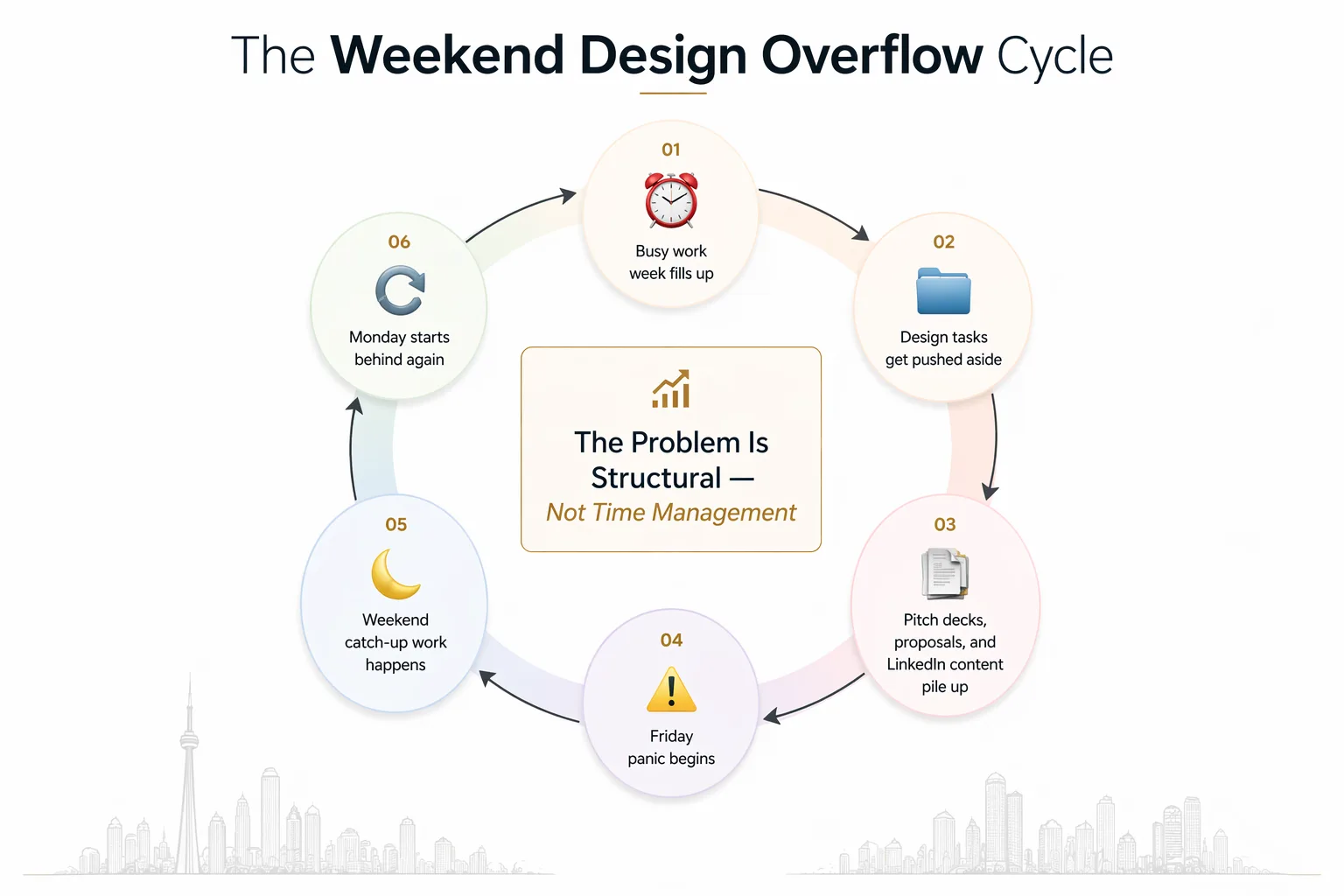
It happens to almost every founder of a growing business in the GTA. In fact, it is so common that most people assume it is simply part of running a business at this stage. The week fills up and the real work gets done. However, everything else slides. Then Friday arrives and you realise the pitch deck for Monday is not finished, the LinkedIn post you planned never went up, and the proposal template still uses last year's branding. So you spend part of your weekend on it. Again. In other words, the weekend is where your marketing backlog goes to get done.
For marketing managers at agencies, consultancies, and professional service firms, this is not occasional — it is the default state. Indeed, most describe it as a permanent feature of the job rather than a temporary phase. It has a name: design overflow. Specifically, it describes what happens when design demand consistently exceeds the capacity of the current system. Consequently, it is not solved by working harder or managing time better. Changing the system solves it — specifically, the structure that keeps design on your plate in the first place.
Why It Keeps Happening
This pattern is not a time management problem. Rather, it is a structural problem. Design and marketing execution require attention and creative decision-making, which means they compete with everything else in your week. When the week fills up — and it always does — they get pushed to the margins. In practice, that means evenings, mornings, or weekends. The only way to break the pattern is to remove the tasks from your plate structurally. Specifically, that means a structural change in who owns the work — not a scheduling change. Managing them better does not work. Ultimately, they will always lose to a client call or a revenue opportunity.
You can block time for design on Tuesday. However, a client call, a team issue, or a revenue-generating opportunity will push it out. Design work gets deprioritised because it can always be done later. That is its defining characteristic. In other words, it is always technically deferrable, which is exactly why it never gets done on time. The structural nature of this problem is why it persists despite good intentions and better calendars. Indeed, the fix is not a new productivity system or a better editorial calendar. It means removing the category of work from your responsibility entirely. Specifically, that means putting someone in place whose job it is to ensure those materials get done.
Equally, OECD research consistently highlights that regulatory and administrative burdens are a key constraint on SME productivity and growth across member economies. These burdens disproportionately affect smaller firms, limiting their operational capacity and slowing the pace at which they can scale.
The Three Things That Keep Design on Your Plate
No dedicated owner
When nobody owns design output specifically, it defaults to the founder or the most available person on the marketing team — by gravity. Design work expands to fill whatever space is available. That space is always the evenings and weekends of whoever is most conscientious about the business.
Reactive briefing
Without someone already holding your brand context, every design request requires your time to initiate and explain. The designer does not know what you want until you tell them. Telling them takes time you do not have during the week. Consequently, it accumulates until the weekend.
Review dependency
When the quality coming back is not consistently on-brand, you become the quality control layer. Every deliverable passes through your calendar. Instead of design coming off your plate, it just changes form: from doing it yourself to reviewing someone else's work and sending it back.
The review dependency is often the most insidious element. Founders who move to a freelancer model to escape doing design often find they have simply traded one form of time consumption for another. The actual design work is gone. However, the management work — briefing, reviewing, revising, chasing — absorbs nearly as many hours. Research from Deloitte and HubSpot consistently shows that fragmented marketing operations and tool overload significantly increase non-core workload for marketing teams, reducing time available for strategic and revenue-generating work. In practice, this operational fragmentation often manifests as repeated formatting, asset management, and coordination tasks across campaigns.
This is the same structural issue that makes the freelancer model fundamentally inefficient for growing businesses — the management overhead never fully goes away, it just changes shape.
What Removing It Structurally Actually Looks Like
Removing design from your plate requires a partner who already holds your brand context. They produce output that matches your standard without revision marathons and initiate work proactively rather than waiting for a brief. This is the specific difference between a freelancer model and a dedicated monthly design partnership.
With Pixie Creative, GTA business owners and marketing managers send a short note and the work gets done to the correct standard — no weekend catch-up required, no briefing from scratch, no chasing. If you are not sure what that looks like in practice, this breakdown of exactly what a monthly design retainer includes explains the scope, the process, and the cost at each tier.
The change in the experience of running a growing business when design is truly off the plate is more significant than most founders anticipate. It is not just the hours that come back — it is the mental load that disappears. The background stress of the proposal that needs updating before Monday, the nagging awareness that LinkedIn has not been active enough. When a reliable partner holds the function, all of that clears.
Most founders describe the shift in one word: clarity. Not just more time, but a fundamentally different relationship with their week and their strategic priorities. Furthermore, the compounding effect of consistent design execution means the business starts showing up in the market the way it is capable. Rather than in the best approximation it can manage while the founder runs everything else simultaneously.
The silent deal breaker post explains the compounding cost of inconsistent visual execution in business development terms — and why getting design off your plate is directly connected to better close rates.
The Practical Test
If you are unsure whether design overflow is your problem, run this quick check. Count the hours you or your marketing manager spent on design-related tasks last month. That includes not just designing, but briefing, reviewing, chasing, and revising. Multiply that by your hourly rate. Compare that number to the cost of a dedicated monthly design partnership. Specifically, Pixie Creative's Essential tier starts at $1,500 per month. For most growing GTA businesses, the maths resolves clearly in favour of the partnership. Notably, most businesses find the gap is wider than they expected once they count honestly.
Frequently Asked Questions
Is this relevant if we already have a marketing manager?
Yes — in fact, it is most relevant for businesses that do have a marketing manager. A senior marketing hire should be spending their time on strategy, campaigns, and partnerships. Instead, most marketing managers at growing GTA businesses spend four to ten hours per week on design execution. That is four to ten hours of strategic capacity going to graphic production every week. Ultimately, it is the most expensive misallocation most marketing managers have on their calendar. A dedicated design partner gives that capacity back entirely.
What if our design needs are not consistent every month?
That is more common than it sounds, and it is exactly what a scoped monthly retainer accommodates. Specifically, the scope is set based on your realistic average volume — not a fixed number of assets. In months where production is lighter, the partner uses that time to build template libraries and brand assets that serve future months. As a result, every month produces value — not just the heavy ones.
How quickly does the weekend design session go away?
Most Pixie Creative clients describe the shift happening within the first two to three weeks. The onboarding session transfers brand knowledge to the designer in week one. Above all, that single session replaces every brief you would otherwise have written. The designer then handles requests without significant briefing overhead from week two onwards. Moreover, most clients describe this as one of the most noticeable operational shifts they have made. If you want to know whether your business has already hit the point where this model makes sense, the five signs you have outgrown one-off design gives you a clear framework.
Get design off your weekend. Book a discovery call with Pixie Creative.
Get in touchPixie Creative is a Toronto-based monthly design partner for GTA professional services firms — including law firms, consulting businesses, and financial services companies. Founded by Maryam, Pixie Creative provides dedicated design support without the freelancer chaos or subscription queue overhead.