If you run a scaling business in Toronto, you already know that people judge fast. You have spent years becoming the expert. Whatever your field, that expertise is real and earned. It belongs to you. However, one thing speaks for you before you say a word: your visuals. In fact, for a significant number of growing businesses in the GTA, that visual signal quietly contradicts everything else they have built.
When a business is scaling, it is easy to let the look of things slide. You are managing clients, leading your team, and closing deals. Understandably, design sits at the bottom of the priority list. Specifically, design feels like something you will address properly when there is more time. As a result, here is what happens while you are busy: your prospects are forming an opinion. That opinion lands in seconds. Specifically, it forms before a single word of your content is read. Your LinkedIn banner, your pitch deck, and your proposal template shape it, above all else. All of that happens before they have read a single word and it sets the frame for everything that follows.
In a competitive market like Toronto, a trust gap does not just look unprofessional. In practice, it costs you contracts. In Toronto's competitive market, every client-facing business is competing for the same high-value clients and perception is part of what wins or loses the room. Moreover, they are all competing on perception as much as capability. If your materials do not match your calibre, you lose ground silently. That loss is rarely visible until it is already significant. By that point, the repair work is harder.
What Your Prospects Are Actually Thinking
When a potential client reviews your materials, they are not simply reading the content. In reality, they are running a rapid credibility assessment. Every visual element is evidence. They are making fast, unconscious judgements about what your business is and whether it deserves their trust. These judgements happen in milliseconds. Notably, they happen before any conscious evaluation begins. Consequently, they are almost impossible to reverse once formed.
They are asking: Are they established? Amateur visuals signal inexperience — regardless of how long you have been operating. Beyond that, they are asking: Do they care about details? If you do not sweat the details of your own brand, why would they trust you with theirs? Finally, they are asking: Can I justify this fee? Above all, people do not pay premium prices for things that look budget-built.
Notably, these are not unfair assumptions. These are how decisions get made at the executive level in 2026. Indeed, no amount of strong content inside a poorly designed document can fully override a weak first visual impression. Research from Lindgaard et al. published in Behaviour & Information Technology shows that users form visual judgments of websites in as little as 50 milliseconds (0.05 seconds). That happens before a single word registers. In other words, the visual quality of your materials determines whether you get a chance to make your case at all.
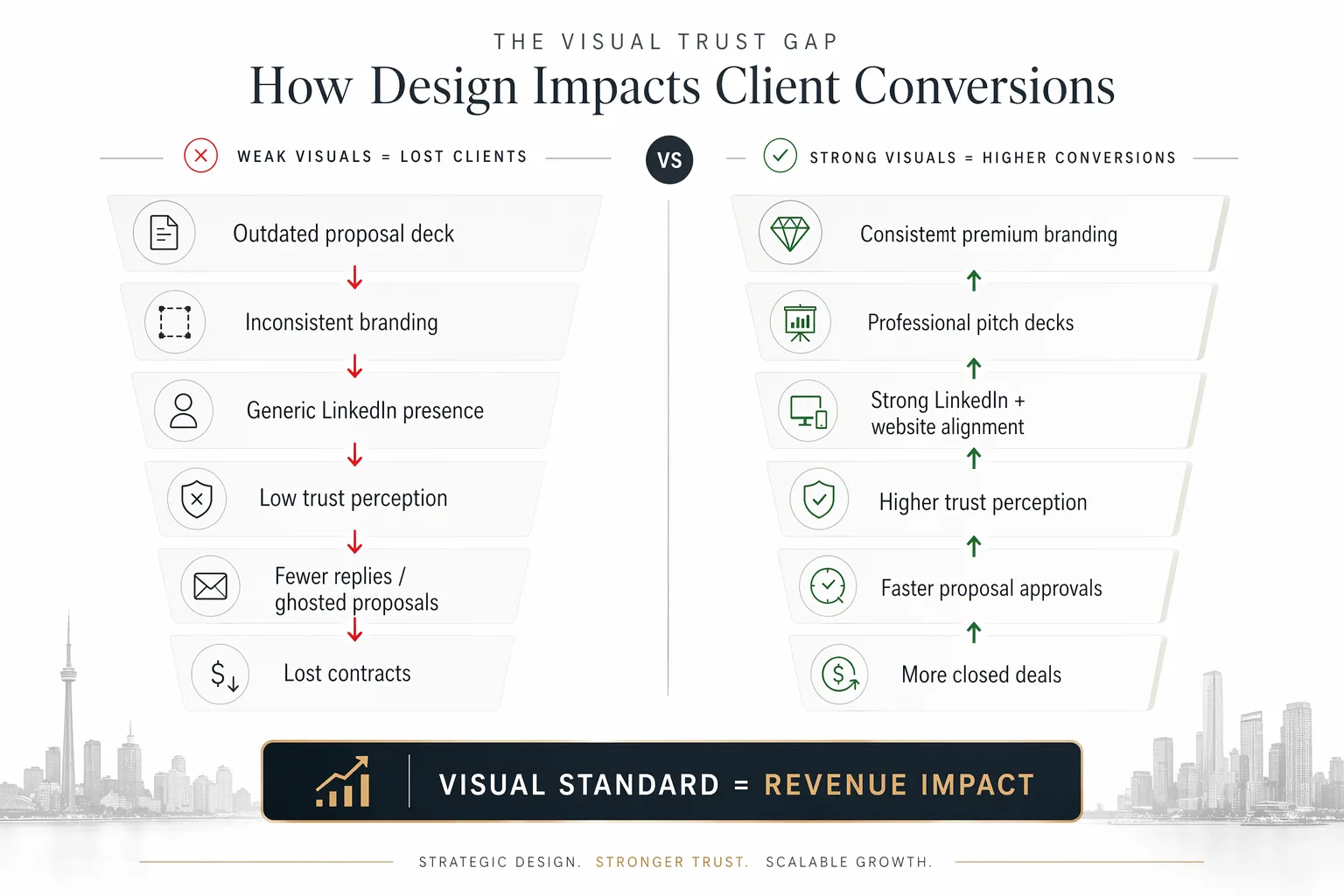
The Franken-Brand Problem Facing Growing GTA Businesses
As your team grows, design tends to happen reactively. A team member makes a quick graphic in Canva. A freelancer updates the LinkedIn banner without seeing the style guide. As a result, small inconsistencies multiply across every touchpoint. Over time, you end up with what practitioners call a Franken-brand, a collection of assets that almost match, but do not quite.
Specifically, the colours are close but not identical. Fonts drift between materials. Logo versions vary across documents. The tone shifts week to week. Over time, this creates design debt. Visual inconsistencies pile up quietly and surface at the worst possible moment: a high-stakes pitch, a new client introduction, a referral follow-up. That is when the gap between how good you actually are and how you look becomes painfully visible.
For Toronto-based scaling businesses, agencies, consultancies, enterprise teams, and founder-led firms, inconsistent branding directly undermines the authority positioning that justifies your fees. Moreover, the damage is invisible until it is already significant.
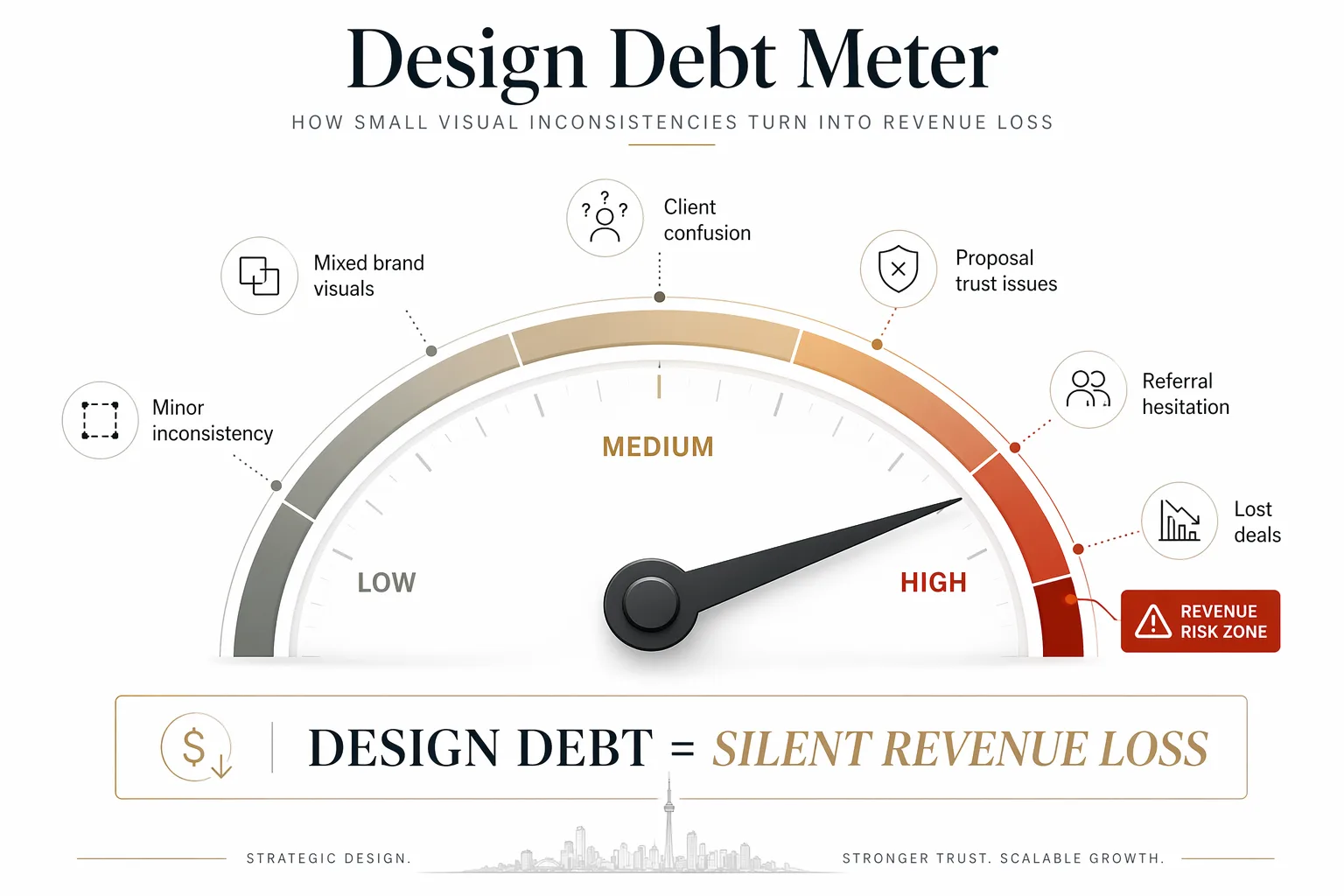
What the Trust Gap Actually Costs You
Most business owners underestimate the trust gap. You do not receive an email saying your competitor won because your pitch deck looked dated. Instead, you simply do not hear back. The deal simply goes quiet. Consequently, the referral does not convert either.
For GTA businesses charging premium fees, one lost deal per quarter attributable to visual credibility is a meaningful financial cost. Against a monthly design investment of $2,500 to $3,500, the return calculates clearly.
That compounding effect is what makes the gap most damaging. Each individual interaction where your materials underrepresent your calibre is a small miss. However, across a year of pitches, proposals, referral follow-ups, and LinkedIn impressions, those small misses accumulate into a reputation gap. You become known as a business that is genuinely good but somehow does not look the part. In Toronto's premium market, reputation forms in aggregate, not in any single interaction. That makes it difficult to reverse.
The most strategically aware businesses in the GTA have therefore started treating their visual trust gap as a revenue metric. Reframe the question. Instead of asking how much fixing your design costs, ask how much your current visual standard is costing you in lost deals per quarter. The investment calculation changes entirely.
Consider the numbers directly. A $3,000 per month design partnership that closes one additional engagement per quarter at $15,000 generates a 5:1 return. As design consistency compounds over six to twelve months, that ratio improves further. Equally, CFIB research consistently shows that growth barriers for Canadian mid-sized businesses are often structural rather than operational—labour shortages, financing constraints, market access, rising costs, and competitive positioning all rank among the most common obstacles to scaling. When perception weakens trust at the buyer level, those barriers become even harder to overcome.
The Referral Network Effect Most GTA Businesses Miss
Furthermore, there is a referral network effect that most GTA founders underestimate. Your referral partners put their own reputation on the line with every introduction. Those accountants, advisors, and agency connections will not send their best clients to a business whose materials might undermine the recommendation. When your visual standard rises to match your actual quality, referral partners become more willing to send high-value introductions proactively.
In other words, the premium visual standard does not just impress the clients you are pitching. It unlocks the clients you are never in the room to pitch at all.
What Premium Visual Execution Actually Means in 2026
In 2026, premium visual execution is not about being the most creatively designed business in the GTA. Instead, it is about consistency, credibility, and the absence of friction. A business with strong visual execution looks the same in every context. The proposal a prospect receives is consistent with the LinkedIn post that first caught their eye. That post is consistent with the website they browsed before the meeting. Ultimately, every touchpoint tells the same story — and that story is one of an organised, well-run, established business worth the premium.
AI tools like Canva AI and Adobe Firefly have raised the floor of design quality dramatically. What looked polished three years ago now looks generic. As a result, the gap between acceptable and genuinely premium has never been easier for executive buyers to spot. These tools have not eliminated the need for professional design support. Rather, they have raised the stakes for what professional actually means.
Not sure whether your current visual standard is holding you back? This guide to the signs your business has outgrown the one-off design model is a useful place to start.
The Compounding Return on Getting It Right
When your visual identity consistently communicates at the level of your actual expertise, something specific happens: trust builds faster. Prospects who find you online after a referral feel confident before the first call. Specifically, they arrive already convinced. Additionally, proposals get approved with fewer pricing objections. Referral partners feel comfortable sending their most valuable clients because your materials reflect the quality of work they are vouching for.
This is the compounding return on consistent, professional design. That is why the most strategically aware scaling businesses in Toronto treat their visual identity as a revenue-generating asset rather than a cost centre.
The transformation most businesses describe after addressing the trust gap is cumulative rather than sudden. Deals that previously went quiet start converting. Furthermore, response times to proposals shorten. Prospects arrive to calls having already done research that confirmed rather than undermined the in-person impression. Notably, none of this shows up in a single metric. It shows up across three to six months of business development outcomes that are measurably better than the ones before.
The Solution: A Dedicated Monthly Design Partner
The answer is not another freelancer or a subscription platform ticket queue. Both of those models still leave the briefing, thinking, and quality control on your plate. The answer is a monthly design partnership. One senior designer becomes embedded in your business. They learn your brand as well as you do and handle your marketing collateral every month — without requiring management.
Specifically, Pixie Creative works with GTA-based scaling businesses — agencies, brokerages, consultancies, mid-market services firms, and executive-led teams as their dedicated monthly design partner. This is not a subscription queue. It is a working relationship where your brand receives consistent, strategic attention every single month, without you project-managing it.
The onboarding process transfers brand knowledge quickly and completely. Within the first two weeks, your dedicated designer has absorbed your brand standards, your client context, your competitive positioning, and your upcoming projects. From that point, the briefing process for standard assets takes minutes rather than hours. As a result, the management overhead disappears. Your marketing materials start reflecting the actual calibre of your business — consistently, on schedule, with no one's weekend consumed by it.
Wondering what this actually costs? In fact, the numbers often surprise businesses that have been absorbing the cost in other ways. See Pixie Creative's monthly partnership tiers and what each one includes.
Not sure whether the problem is structural or creative? This post on why growing businesses look inconsistent explains exactly why it keeps happening — and how to fix it.
When your visuals match your expertise, two things happen: your price becomes easier to justify, and your credibility becomes easier to build. The silent deal breaker becomes a silent deal maker.
Frequently Asked Questions
How do I know if I have a trust gap?
The fastest test is straightforward. Show your pitch deck, LinkedIn profile, and website to someone who does not know your business and ask what they think you charge. If their estimate is meaningfully lower than your actual fees, the gap exists. That gap is costing you money every month it remains. Furthermore, it compounds as your business grows.
Does this work for solo professionals, not just larger teams?
Absolutely. In fact, solo and small-team professionals often feel the trust gap most acutely because their personal brand IS the business. Realtors, mortgage brokers, financial advisors, and clinic owners are exactly who this model was built for.
How quickly can a monthly design partner fix the trust gap?
Most Pixie Creative clients see a material difference within the first two to three weeks. Furthermore, the compounding effect on business development outcomes typically becomes visible over three to six months.
Is this relevant if we already have some brand guidelines?
Yes, and more commonly than most businesses expect. Brand guidelines are a reference document. In practice, they do not enforce themselves. The trust gap closes when someone applies those guidelines consistently to every deliverable. That is exactly what a dedicated monthly design partner does by default.
Ready to close the trust gap? Book a discovery call with me.
Get in touchPixie Creative is a Toronto-based monthly design partner for GTA professional services firms — including law firms, consulting businesses, and financial services companies. Founded by Maryam, Pixie Creative provides dedicated design support without the freelancer chaos or subscription queue overhead.