On paper, a flat-rate unlimited design platform sounds like every marketing manager's dream. One monthly fee. Unlimited requests. Designs back in 24 to 48 hours. No invoices, no project negotiations, no chasing freelancers.
Three weeks in, most business owners and marketing managers figure out they've traded doing the design for managing a design factory. The promise is real. The delivery is something different.
If you've been searching for a Design Pickle alternative in Toronto or you're a marketing manager wondering why your subscription platform is eating your afternoon instead of saving it, this is the honest breakdown.
What is Design Pickle, and why does everyone try it?
Design Pickle is one of the most well-known unlimited design subscription platforms. Pay a flat monthly fee (roughly $500 to $1,600+ USD depending on the tier), submit requests through a queue, and get completed work back within 24 to 48 hours. Teamtown and a handful of other platforms run the same model.
For the right business, these platforms deliver exactly what they promise. If you're running an e-commerce brand and you need 30 product social posts a month in a repeatable template, the queue model works. Volume is high, briefs are simple, formats are consistent. The economics make sense.
The model starts to break down when your business has grown past that use case. When your brand needs to do more than fill a content calendar, when your deliverables are more complex than a templated post, and when the person managing the design requests (often a marketing manager or the founder themselves) is already stretched thin.
Why do marketing managers end up hating subscription design platforms?
This is the part the platform demos don't show you.
Subscription platforms are built around a queue. You submit a brief, a designer executes it, you review, you request revisions, you re-review. The platform processes the ticket. You manage everything else: what to submit, how to brief it, whether the output is right, what the next round of feedback should be.
For a marketing manager at a growing business, this isn't a creative solution. It's a second job.
The management overhead is a structural feature of the model, not an accident. Subscription platforms are optimised for throughput, as many requests completed per designer per day as possible. That throughput incentive means designers gravitate toward briefs they can execute quickly: simple, templated, and clearly specified. The more complex your needs- a pitch deck with strategic structure, a brand asset that has to communicate something specific, a campaign that needs to feel like it came from a real brand- the more revision cycles you eat, because those are the deliverables that are hardest to execute from a brief alone.
The marketing manager becomes the translator between the business's creative vision and a designer who has never met anyone from the company. Every single time.
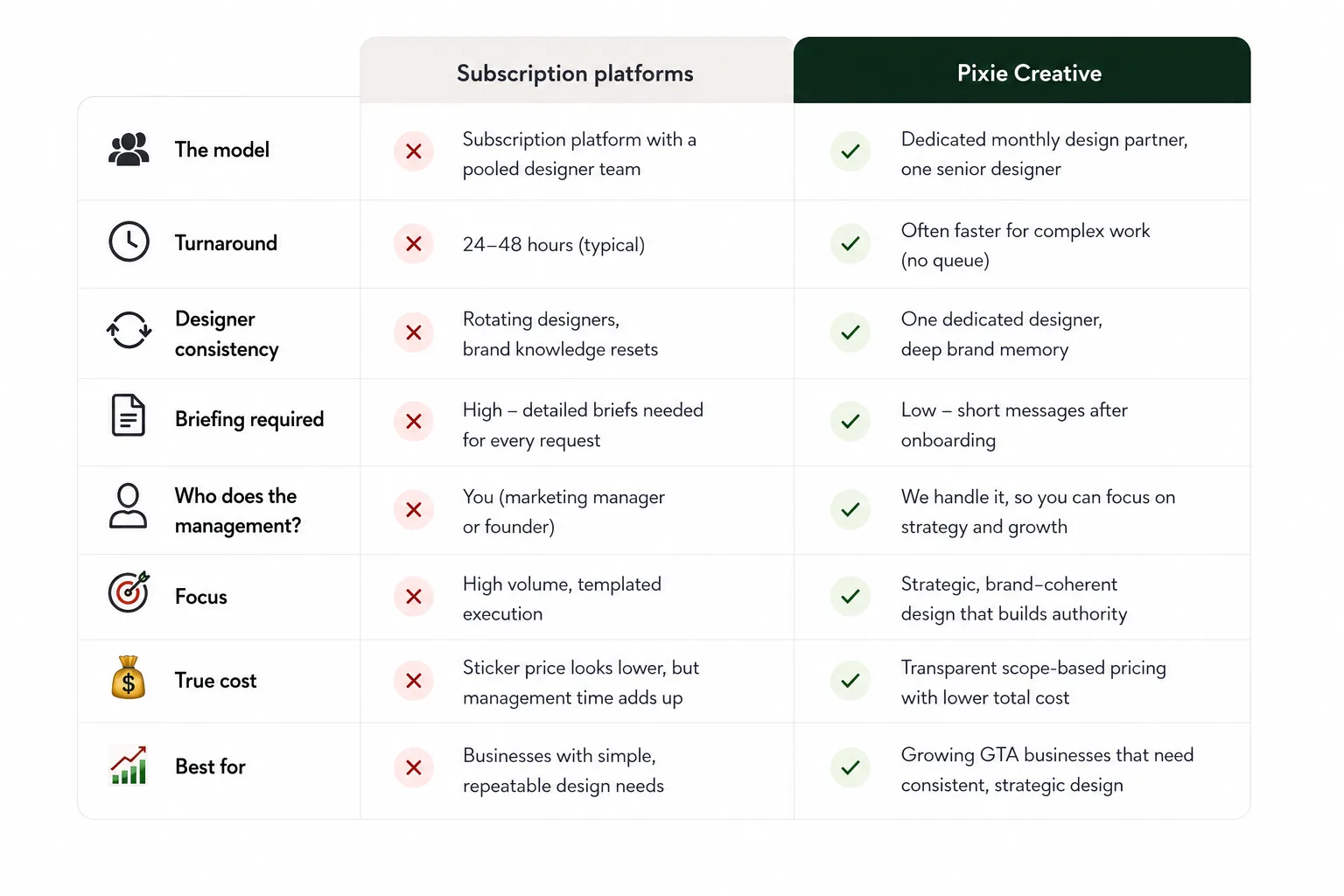
What does "brief writing" actually cost a marketing manager?
This is where the math stops working, and most people don't run the numbers until they're already three months in.
Subscription platforms are only as good as the briefs you submit. For simple, repeatable deliverables, writing a brief is fast. For anything with real strategic weight: a branded content piece, a proposal document, a campaign visual that needs to communicate a specific positioning, writing a useful brief takes 20 to 30 minutes. You're communicating context, tone, audience, competitive landscape, and brand nuance that a designer who has never worked with your company doesn't already know.
If you're a marketing manager submitting eight complex requests a month and spending 25 minutes briefing each one, you've spent three hours per month just writing briefs before a single revision. Before a single back-and-forth. Before the approval cycle.
Then multiply that by revision rounds. If the first draft comes back technically correct but strategically flat (which it often does, because the designer executed the brief without the brand context behind it), you're now writing revision notes. Two or three rounds later, you've spent more time managing the request than it would have taken to produce a rough version yourself.
A dedicated partner who already holds your brand context eliminates most of this after the first month. A short message replaces a detailed document. That shift compounds fast.
The brand memory problem with pooled designer teams
Most subscription platforms, Design Pickle and Teamtown included, use pooled or rotating designer teams. Your "dedicated" designer has a capped availability, and when they're not available, another designer picks up the work starting from scratch on your brand.
Over time, this produces what designers call the Franken-brand: a collection of assets that are each technically on-brief but don't look like they came from the same company. Different type treatments, slightly off colours, varying layout logic, inconsistent use of space.
For a business that's paying attention to how it looks, which is exactly the type of business reading this, that inconsistency is expensive. It dilutes the authority signal your brand is supposed to be building. It means every new asset does a little less work for your brand equity instead of a little more.
The fix is structural. It's not about writing better briefs or choosing better revision feedback. It's about having one designer who carries your brand knowledge across every deliverable, every month, indefinitely. That's something a rotation model cannot provide by design.
The total cost of ownership nobody talks about
Here's the comparison most people make: Design Pickle at $700 USD per month versus a dedicated design partner at $1,500 to $3,500 CAD per month. The subscription platform looks cheaper. The comparison ends there and people sign up.
Here's the comparison nobody makes: what does the subscription model actually cost when you include the time of the person running it?
If a marketing manager is spending five to eight hours a month on brief writing, revision management, and design project coordination, which is conservative for a growing business with real creative output, and that manager's time is worth $40 to $80 per hour, the real monthly cost of the subscription model is $900 to $1,800 in absorbed labour before you factor in the platform fee. Add the platform fee and you're at $1,600 to $2,500 USD. That's before accounting for the quality gap on complex deliverables.
For most growing GTA businesses, the dedicated partner model is not more expensive. It just looks more expensive on the invoice because the management cost is invisible, it shows up in someone's afternoons instead of on a line item.
Who is this actually a problem for?
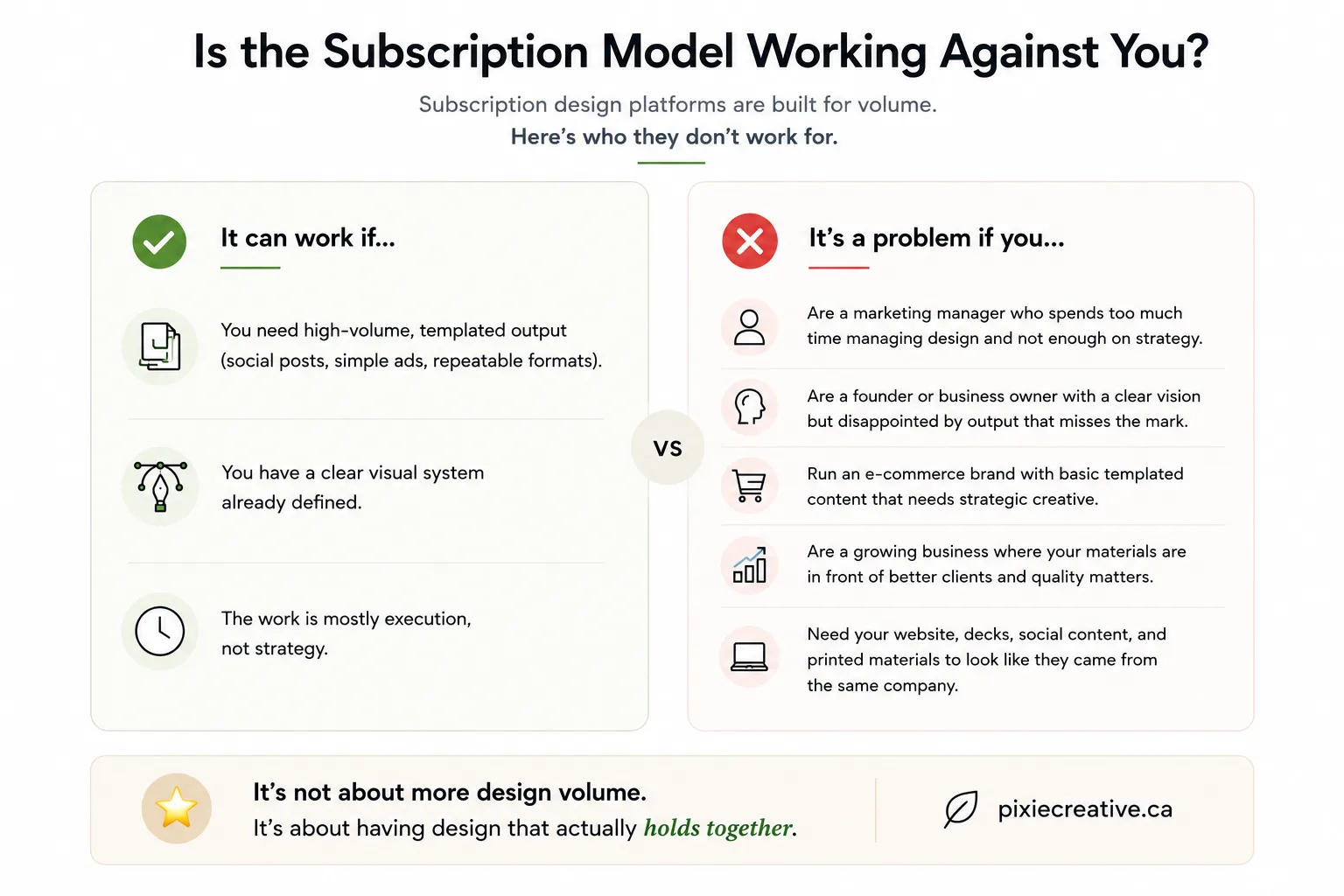
If your design needs are genuinely high-volume and templated. You need a lot of social posts in an established format, you have a clear visual system already defined, and the work is mostly execution, subscription platforms can serve you well. That's the use case they're built for.
If any of the following describes your situation, the subscription model is working against you:
You're a marketing manager who spends too much time managing the design process and not enough time on strategy or campaigns. You're a founder or business owner who has a real sense of how your brand should look and feel, and you're constantly disappointed by output that's technically correct but spiritually wrong. You're an e-commerce brand that has grown past basic templated content and now needs strategic creative that reflects a more developed brand. You're running a growing business where your materials are getting in front of better clients and the quality bar has genuinely gone up. You need your website, your decks, your social content, and your printed materials to look like they came from the same company because right now they don't.
That last one is the most common. Most businesses that reach out about a Design Pickle alternative aren't looking for more design volume. They're looking for design that actually holds together.
How Pixie Creative works differently
Pixie Creative is a Toronto-based dedicated monthly design partner for GTA businesses. Not a subscription queue. Not a rotating team of designers. One dedicated senior designer who builds deep brand knowledge over time and works as an embedded creative partner, thinking ahead, not just executing tickets.
The model is scope-based, not volume-based. Each monthly engagement is built around what your business actually needs to produce that month: presentation decks, proposal documents, campaign visuals, social content, email newsletters, website updates, brand assets, print collateral. The full services list is here.
After the onboarding month, the briefing overhead drops dramatically. Your designer already knows your brand, your clients, your tone, and your standards. A two-line message replaces a 25-minute brief. Revision rounds decrease because the first draft is already calibrated to your brand, not just your instructions. You stop managing a design process and start having a creative partner.
The How It Works page walks through what onboarding looks like and what to expect in the first 30 days.
The side-by-side that actually matters
The question worth asking
Before you sign up for another subscription platform or look for a cheaper version of the one that didn't work, it's worth asking what problem you're actually trying to solve.
If the problem is volume, a subscription platform might be right. If the problem is that your brand doesn't look consistent, that your marketing manager is spending too much time managing design and not enough on actual marketing, that your output doesn't reflect the quality of your business anymore, that's not a volume problem. That's a relationship problem. And it needs a different solution.
People also ask
Is Design Pickle worth it for a growing business in Toronto?
It depends on your design needs. If you need high-volume, templated output — social posts, simple ads, repeatable formats — subscription platforms like Design Pickle can deliver good value. If your needs are more strategic, brand-sensitive, or complex, the brief-required queue model creates management overhead and brand inconsistency that make it a poor fit. Most growing GTA businesses find that the total cost, including the time of whoever manages the platform, is higher than the sticker price suggests.
What is a good Design Pickle alternative in Toronto?
For businesses that need consistent, strategic, brand-coherent design, not just volume, a dedicated monthly design partner is the most common alternative. Pixie Creative is Toronto-based and works with growing GTA businesses that have outgrown the subscription queue model.
Why does my brand look inconsistent when I use a design subscription service?
Subscription platforms use pooled or rotating designer teams. Each time a new designer picks up your work, they start fresh on your brand context. Over time this creates visual inconsistency across your assets: different spacing, slightly off colours, inconsistent layout logic. The fix is a single dedicated designer who holds your brand knowledge across every deliverable, every month.
How much does a dedicated design partner cost compared to Design Pickle?
Design Pickle plans range from roughly $500 to $1,600+ USD per month. Pixie Creative's dedicated partnerships start at $1,500 CAD per month. When you factor in the time cost of brief writing, revision management, and design coordination that the subscription model puts on your team, most businesses find the dedicated model is comparable or lower in total cost.
My marketing manager spends too much time managing our design process. What's the fix?
The brief-required queue model of subscription platforms puts the management burden on the person submitting requests. A dedicated design partner who already knows your brand shifts that burden off your marketing manager: fewer briefs to write, fewer revision cycles, less back-and-forth. It's a structural fix, not a workflow hack.
See if Pixie Creative is the right fit. Book a 15-minute walkthrough at pixiecreative.ca.
Get in touchPixie Creative is a Toronto-based monthly design partner for GTA professional services firms — including law firms, consulting businesses, and financial services companies. Founded by Maryam, Pixie Creative provides dedicated design support without the freelancer chaos or subscription queue overhead.