Writing design briefs shouldn't feel like a second job
If you've ever blocked off an hour in your calendar just to explain a simple design request, you're not alone. For many founders, marketing managers, COOs, and business development leaders across Toronto and the GTA, creating a design brief for professional services has quietly become one of the biggest hidden costs in the creative process.
Ironically, the actual design task might only take fifteen or twenty minutes. Yet before a designer even opens Adobe Illustrator or Figma, someone inside the business has already spent valuable leadership time gathering context, explaining goals, finding reference images, checking brand colours, clarifying deadlines, and answering follow-up questions.
None of this appears on an invoice.
It rarely shows up in project budgets.
But it consumes hours every month.
For growing professional service firms—from wealth management practices in Toronto's Financial District to consulting firms in North York, law offices in Vaughan, and accounting firms in Mississauga—this "briefing tax" compounds as marketing activity increases. Every brochure, proposal, presentation, social graphic, event banner, recruitment campaign, and website update requires someone internally to stop what they're doing and translate business knowledge into instructions.
That translation work has a cost.
And unlike graphic design itself, it almost never creates new value.
Instead, it simply transfers information that already exists inside your business.
The question isn't whether you should brief a designer.
The better question is:
How much time should briefing actually require?
For businesses working with a strategic design partner rather than rotating freelancers, the answer is surprisingly little.
Why briefing has become such a bottleneck for growing Toronto businesses
As companies grow, design requests become more frequent.
Marketing campaigns expand.
Sales teams need updated presentations.
HR requires recruitment materials.
Business development wants conference banners.
Leadership announces new services.
Suddenly, instead of producing one design project every few months, dozens of small creative requests appear throughout the month.
Each request demands context.
Unfortunately, context doesn't scale very well.
A freelancer who worked with you three months ago probably doesn't remember:
Which logo variation should be used.
Your preferred photography style.
Which messaging resonates with financial executives.
Which colour combinations leadership dislikes.
Why your last campaign performed well.
The tone your managing partner prefers on LinkedIn.
How your proposal templates are structured.
Every project starts almost from zero.
That means every request requires another explanation.
The larger your business becomes, the more expensive this repetitive communication gets.
For many GTA firms, briefing becomes a bigger operational problem than the design work itself.
What a good design brief actually includes
A design brief isn't simply a list of instructions.
It's a decision-making framework.
When written well, it gives the designer enough strategic context to make hundreds of small creative decisions without needing constant clarification.
Whether you're working with a freelancer, an agency, or a Toronto design studio, an effective brief typically includes several essential elements.
1. The business objective
Many briefs begin with the deliverable.
Instead, they should begin with the outcome.
Rather than saying:
"Create a brochure."
Explain why.
For example:
"We're attending a Bay Street networking event next month and need a leave-behind that positions us as specialists in succession planning for owner-managed businesses."
Now the designer understands the business problem—not just the format.
That changes every design decision.
2. The audience
Design is communication.
Communication changes depending on who is receiving it.
A LinkedIn graphic aimed at startup founders will look and feel very different from one targeting executives at established accounting firms.
Specific audiences produce stronger creative work.
Compare these examples.
Weak audience definition
"Our clients."
Strong audience definition
"Managing partners at boutique law firms across the GTA with 15–50 employees who are evaluating outsourced marketing support."
The second brief immediately influences typography, imagery, messaging hierarchy, colour usage, and overall visual tone.
3. Brand standards
This sounds obvious, but many businesses assume designers will "figure it out."
Brand standards should include:
Primary and secondary logos
Colour palette
Typography
Image style
Tone of voice
Logo spacing rules
Accessibility considerations
Existing templates
Any mandatory compliance language
Professional service firms especially benefit from consistency because trust is built through familiarity.
Every inconsistent visual signal creates friction.
4. Success criteria
How will you know the project worked?
This question is rarely included.
Examples might include:
Increase webinar registrations.
Support a sales conversation.
Improve proposal professionalism.
Encourage LinkedIn engagement.
Generate event inquiries.
Make complex financial information easier to understand.
Knowing the measure of success allows designers to prioritize clarity over decoration.
5. Practical constraints
Finally, include the operational details.
These might include:
Dimensions
File formats
Print specifications
Platform requirements
Deadlines
Budget considerations
Approval process
Without these details, even excellent creative work may need unnecessary revisions.
Why most briefs fail before the designer even starts
Interestingly, poor briefs rarely fail because they're too short.
They fail because they're missing strategic context.
Many businesses describe what they want.
Very few explain why.
Consider these two examples.
Example One
"Design an Instagram carousel introducing our new advisory service."
Technically complete.
Strategically weak.
Example Two
"We're launching a new advisory service for privately owned manufacturing companies across Southern Ontario. The goal is to establish credibility before our seminar next month. The audience already understands accounting but not operational consulting. The tone should feel established, knowledgeable, and approachable rather than promotional."
Now the designer understands:
business objective
audience sophistication
marketing funnel stage
emotional tone
communication priorities
The resulting design will almost always require fewer revisions because better decisions are being made from the beginning.
Why revisions often begin before the first draft exists
Many business leaders assume revisions happen after the designer delivers work.
In reality, revisions usually begin much earlier.
Every missing piece of information forces the designer to make assumptions.
Those assumptions may include:
Which imagery best fits the audience.
Which message deserves the headline.
Which colours should dominate.
Whether professionalism or personality should lead.
How formal the copy should feel.
Which business priorities matter most.
The designer isn't making mistakes.
They're filling information gaps.
The more assumptions they must make, the more likely the first draft misses your expectations.
This explains why businesses sometimes feel trapped in endless revision cycles with freelancers.
The revisions aren't caused by poor design.
They're caused by incomplete context.
And every additional revision adds more meetings, more emails, more Slack messages, and more interruptions to everyone's schedule.
By the time the project is approved, the design itself may represent only half of the total effort invested.
Why the brief problem almost disappears in a long-term design partnership
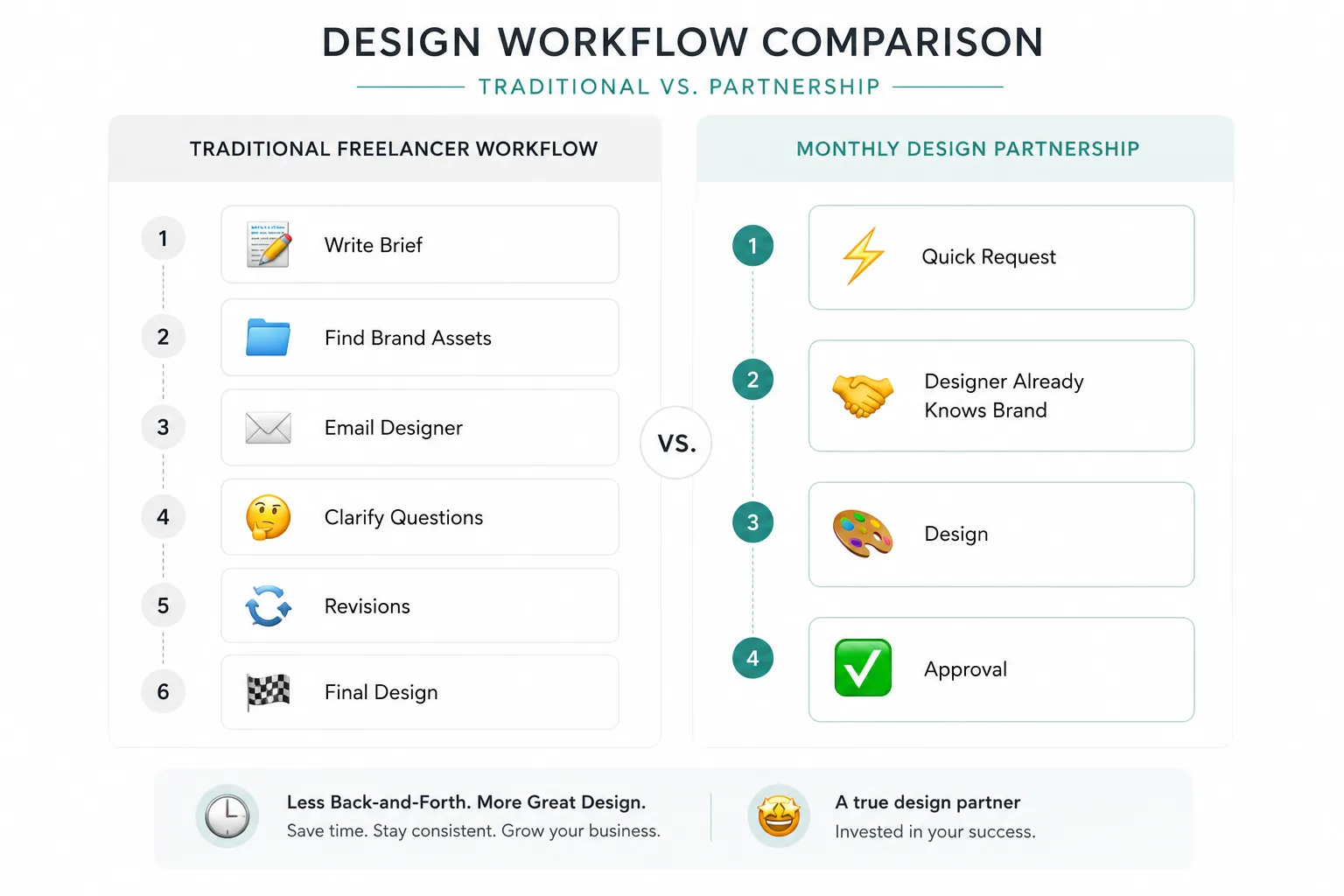
One of the biggest differences between hiring a freelancer for individual projects and working with a monthly design partner isn't turnaround time or pricing.
It's institutional knowledge.
Every project you complete with the same designer builds a shared understanding of your business. Instead of treating every request like a brand-new assignment, your designer begins to recognize patterns, understand priorities, and anticipate decisions before you even ask.
Think about how your internal team operates.
Your sales manager doesn't need a full document explaining your ideal client every Monday morning. Your operations lead doesn't need to be reminded which services are most profitable every time they make a decision.
They already know the business.
A dedicated design partner should eventually reach that same level of familiarity.
That's why the onboarding phase of a design retainer matters so much.
Instead of collecting the same information repeatedly, you invest time once.
That initial discovery typically covers:
Your business goals
Your target audience
Brand positioning
Competitors
Brand identity guidelines
Marketing priorities
Internal approval process
Frequently used assets
Existing templates
Communication preferences
Once that foundation exists, every future request becomes dramatically simpler.
Instead of writing:
"Please create a four-page capabilities brochure for our wealth management division. Use our navy and gold palette, the Gotham font family, keep the tone premium but approachable, include our updated service framework, maintain consistency with the proposal deck, and ensure the layout works for both print and PDF."
You can simply say:
"Can you update the capabilities brochure with our new retirement planning service?"
Everything else is already understood.
The designer knows the brand.
The audience.
The standards.
The expectations.
The decision-making framework already exists.
If you're finding yourself repeatedly explaining the same brand information, it's often a symptom of a larger workflow issue. Our article on The Problem With Freelance Graphic Designers explores why many growing GTA businesses eventually move toward longer-term creative partnerships.
Context becomes more valuable than instructions
Many businesses assume better briefs create better design.
In reality, better context creates better design.
There's an important difference.
Instructions tell a designer what to produce.
Context helps them understand why it matters.
Imagine a Toronto consulting firm preparing for a major conference at the Metro Toronto Convention Centre.
A freelancer might receive this request:
Design three pull-up banners.
A long-term design partner knows much more.
They already understand:
the firm's positioning
which services generate the highest revenue
which industries are being targeted this quarter
how competitors present themselves
previous conference performance
leadership preferences
existing marketing materials
visual hierarchy across the brand
That accumulated knowledge influences every creative decision without requiring another lengthy briefing session.
The work becomes more strategic because the designer isn't simply executing instructions—they're making informed decisions based on months of accumulated business knowledge.
The compounding efficiency of shared knowledge
One of the least discussed benefits of ongoing creative partnerships is that efficiency compounds over time.
The first month naturally involves more communication.
You're introducing your company.
Sharing files.
Explaining your services.
Clarifying your audience.
Establishing expectations.
By the second month, much of that disappears.
By the third month, requests become noticeably shorter.
By month six, something interesting happens.
Your designer begins thinking proactively instead of reactively.
Rather than waiting for instructions, they start noticing opportunities.
They might point out that:
your proposal deck no longer reflects a recently launched service
your LinkedIn graphics feel inconsistent with your website
conference materials should be updated before an upcoming event
recruitment graphics need refreshing after your employer branding update
your website banner still promotes last quarter's campaign
The relationship shifts.
Instead of constantly explaining work, you're reviewing recommendations.
That change saves far more time than simply reducing briefing length.
It changes who carries the creative workload.
The real advantage of a long-term design relationship isn't simply familiarity—it's the accumulation of institutional knowledge. Research discussed by Harvard Business Review highlights how organizational knowledge compounds over time, allowing experienced team members to make better decisions with less communication. The same principle applies to creative partnerships, where shared context gradually replaces repetitive briefing.
Four briefing mistakes Toronto businesses make repeatedly
After working with growing businesses, certain briefing habits appear again and again.
Recognizing them can dramatically improve both project quality and turnaround time.
Mistake #1: Describing the deliverable instead of the objective
This is by far the most common mistake.
Businesses focus on what needs to be designed instead of what the design needs to accomplish.
For example:
"Design a LinkedIn graphic announcing our new service."
This explains the output.
It doesn't explain the goal.
A stronger brief would say:
"We're introducing our outsourced CFO service to owner-managed businesses across the GTA. The goal is to position us as a strategic growth partner rather than simply an accounting firm. The audience already knows our company, but not this new offering."
Now the designer understands the communication challenge.
Design decisions become strategic instead of purely visual.
Mistake #2: Too many conflicting references
Reference images can be incredibly useful.
Too many become confusing.
Businesses sometimes attach fifteen or twenty screenshots collected from Pinterest, LinkedIn, competitors, Behance, Canva templates, and unrelated brands.
Unfortunately, these examples often contradict one another.
Some are minimalist.
Others are colourful.
Some use serif typography.
Others feel highly corporate.
The designer is left trying to combine completely different visual languages into one cohesive piece.
Instead, choose three examples that share a similar direction.
The goal isn't to copy another design.
It's to communicate the feeling you're aiming for.
Quality beats quantity every time.
Mistake #3: Forgetting to define the audience
Design changes dramatically depending on who is reading it.
"Our clients" isn't specific enough.
Consider these audiences instead:
Managing partners at boutique law firms
CFOs of manufacturing companies
First-time homebuyers
Wealth management clients nearing retirement
HR directors at professional service firms
Each audience expects different language, imagery, typography, information hierarchy, and tone.
The clearer the audience, the stronger the creative work becomes.
Mistake #4: Solving the creative problem before the designer can
Some briefs unintentionally remove the value of hiring a designer.
Rather than explaining the challenge, they prescribe every detail of the solution.
For example:
Use a blue background, put this photo on the left, make the headline exactly like this competitor's, use three icons underneath, then finish with this CTA.
If every creative decision has already been made internally, the designer becomes production support rather than a strategic partner.
Ironically, these highly prescriptive briefs often produce weaker outcomes.
Why?
Because they're based on assumptions instead of design expertise.
A stronger approach is to define:
the business objective
the audience
required brand standards
mandatory constraints
Then allow the designer enough creative freedom to solve the communication problem.
The best partnerships balance direction with trust.
The psychology behind better briefs
A useful design brief doesn't answer every question.
It answers the right questions.
Professional designers aren't simply arranging shapes and colours.
They're constantly making decisions about communication.
Every layout asks questions like:
What should someone notice first?
Which message deserves the most emphasis?
Where should the eye travel next?
What creates trust?
What creates urgency?
What should be simplified?
What should be removed?
Those decisions become easier when the business objective is clear.
This is why experienced designers often ask questions that seem unrelated to aesthetics.
Questions about competitors.
Sales conversations.
Customer objections.
Revenue priorities.
Upcoming campaigns.
Marketing goals.
They're gathering context—not delaying the project.
The strongest creative work almost always comes from the strongest understanding of the business.
Briefing becomes collaboration—not administration
Perhaps the biggest shift in an ongoing partnership is psychological.
Design requests stop feeling like administrative tasks.
Instead of opening a blank document and wondering what information needs to be included, you simply start a conversation.
Sometimes it's a quick Slack message.
Sometimes it's a Loom recording.
Sometimes it's a five-minute Teams call while walking between meetings.
The request becomes conversational because the relationship already contains the context.
That may seem like a small operational improvement.
Over twelve months, however, those saved minutes become dozens of hours that founders, marketing managers, and leadership teams can spend on higher-value work instead of repeatedly documenting information the designer should already know.
Modern organizations increasingly compete on operational efficiency as much as technical expertise. McKinsey & Company has written extensively about reducing unnecessary organizational friction so teams can focus on high-value work rather than administrative tasks. Streamlining the creative briefing process is one practical example of removing this kind of friction from everyday operations.
The briefing overhead calculation
Before deciding whether your current creative process is "good enough," try a simple exercise.
Write down every design request your business made over the past month.
Now estimate:
How many separate briefs were written?
How many emails were exchanged before work began?
How many Slack or Teams messages clarified missing information?
How many meetings were scheduled to explain the request?
How many revisions resulted from information that could have been included earlier?
For many growing Toronto businesses, the numbers are surprisingly high.
Let's use a conservative example.
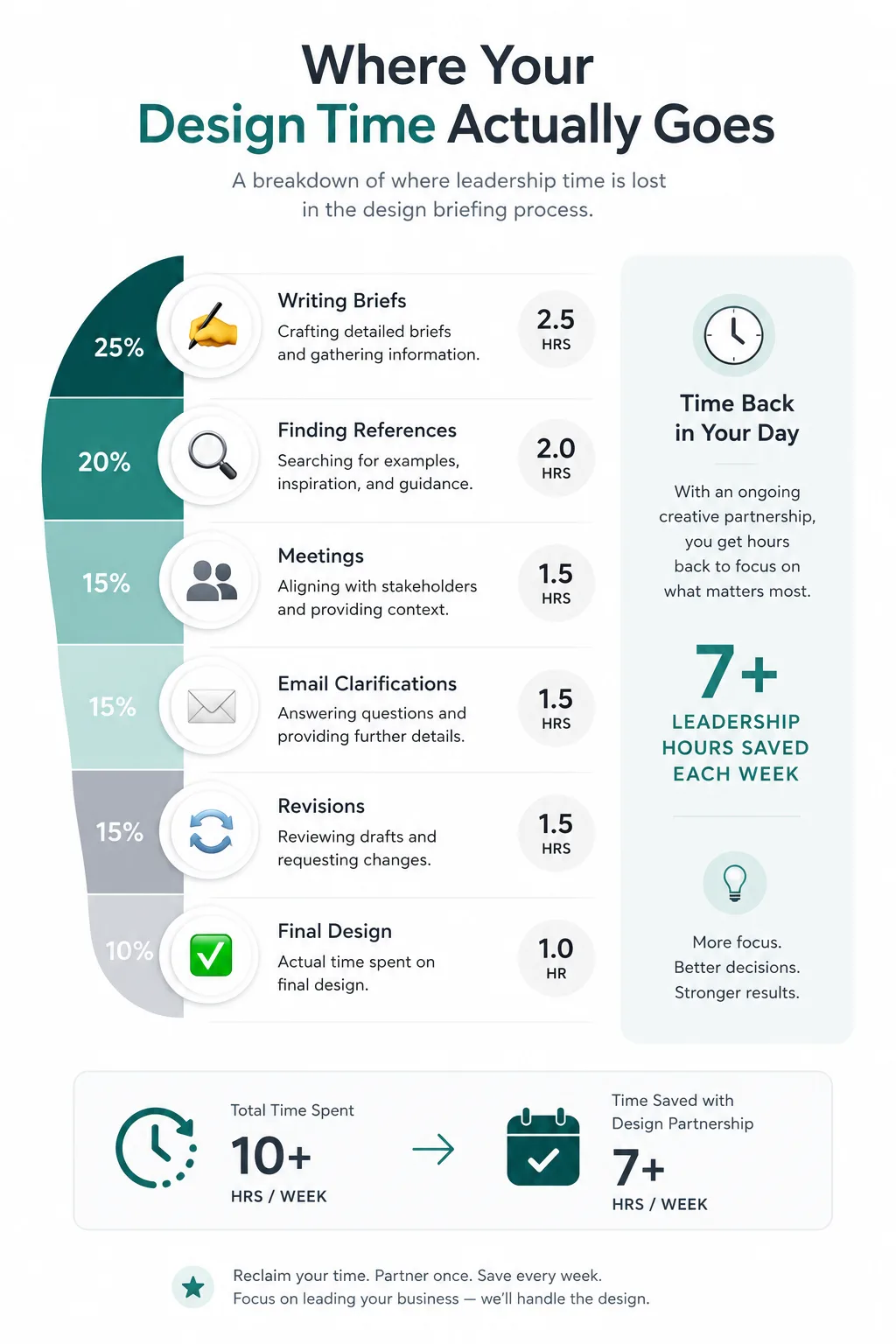
Monthly Briefing Overhead Example
📝 Writing design briefs: ~3 hours
🖼️ Finding reference images: ~1 hour
📧 Explaining projects by email: ~1.5 hours
💬 Answering follow-up questions: ~1 hour
🔄 Managing revisions caused by missing context: ~2 hours
Total leadership time spent before the design work is finished: 8.5 hours every month
Eight and a half hours may not sound significant until you consider who is spending them.
If that time belongs to a founder, CMO, managing partner, or business development manager, those aren't administrative hours—they're leadership hours.
Those are hours that could have been spent:
Meeting prospective clients.
Improving customer experience.
Developing new services.
Coaching your team.
Building strategic partnerships.
Growing revenue.
Instead, they're being spent rewriting information your designer has already seen before.
The hidden cost isn't just the hours.
It's the opportunity cost of what those hours could have produced elsewhere.
Why a monthly design partnership changes the equation
A dedicated monthly design partnership doesn't eliminate communication.
Good communication will always be part of successful creative work.
What changes is the amount of repeated communication.
After a comprehensive onboarding process, your designer already understands:
your visual identity
your preferred tone of voice
your audience
your approval workflow
your templates
your recurring marketing activities
your business priorities
your long-term goals
That means new requests become significantly lighter.
Instead of writing another detailed project brief, you might simply send:
"Let's update the proposal deck with the new advisory package before next week's client meeting."
Or:
"Can you turn yesterday's webinar into three LinkedIn graphics?"
Or:
"The website hero section needs refreshing before our September campaign."
The context already exists.
The request becomes conversational instead of procedural.
Over time, that shift creates something even more valuable than efficiency—it creates momentum.
Marketing moves faster.
Sales collateral stays current.
Brand consistency improves naturally.
Leadership spends less time managing design and more time using it to support business growth.
If you're considering ongoing creative support, our guide on What a Monthly Design Retainer Actually Includes explains what services, workflows, and collaboration you can typically expect from a dedicated design partner.
Good design starts long before the first draft
Many businesses assume great design begins when a designer opens a design program.
In reality, it begins much earlier.
It starts with shared understanding.
The better a designer understands your business, your clients, your positioning, and your goals, the less energy everyone spends explaining the same things over and over again.
That's why businesses that rely on isolated freelance projects often feel like they're constantly starting from scratch.
Every project requires another explanation.
Another document.
Another email thread.
Another round of clarification.
By contrast, businesses working with a long-term creative partner gradually replace documentation with conversation.
The designer becomes an extension of the team rather than an external vendor.
And over months—not weeks—that accumulated knowledge becomes one of the most valuable assets in the relationship.
The goal isn't simply to produce attractive graphics.
It's to build a creative system that removes friction, protects leadership time, and allows marketing to move as quickly as the business itself.
If your team spends more time explaining design than using it, the problem probably isn't your briefing skills.
It's your creative model.
Frequently Asked Questions
What is a design brief?
A design brief is a document or project outline that explains the objective, audience, brand requirements, deliverables, timeline, and constraints for a creative project. A well-written brief helps designers make informed decisions and reduces unnecessary revisions.
How detailed should a design brief be?
A design brief should include enough strategic context for the designer to understand the business objective without becoming unnecessarily long. Focus on goals, audience, brand standards, deadlines, and success criteria rather than trying to dictate every design decision.
Why do design projects require so many revisions?
Many revisions happen because important information wasn't shared at the beginning of the project. Missing context often forces designers to make assumptions that don't match stakeholder expectations.
How can businesses reduce briefing time?
Working with a long-term design partner is one of the most effective ways to reduce briefing time. As the designer learns your business, many requests can be handled through short conversations instead of lengthy documents.
Is a monthly design retainer better than hiring freelancers?
For businesses with recurring creative needs, a monthly design retainer often provides greater efficiency because the designer retains institutional knowledge, understands brand standards, and becomes familiar with internal workflows.
What should every design brief include?
Every design brief should clearly define the project objective, intended audience, brand guidelines, technical requirements, timeline, and any mandatory constraints or approvals.
Why is knowing the audience so important in graphic design?
Different audiences respond to different visual styles, messaging, and layouts. Clearly defining the audience allows designers to create communication that feels relevant and trustworthy.
How long should it take to brief a designer?
For established creative partnerships, many routine requests can be communicated in just a few minutes. New projects or campaigns typically require more detailed discussions during the planning stage.
Can a design studio help improve our internal marketing process?
Yes. Beyond creating visual assets, experienced design studios often streamline workflows, build reusable templates, maintain brand consistency, and reduce the administrative burden of managing creative projects.
When should a business stop using one-off design projects?
If your business creates marketing materials every month and repeatedly explains the same brand information to different freelancers, it may be time to consider an ongoing design partnership.
Conclusion
Writing a thoughtful design brief will always matter.
But your business shouldn't have to start from zero every time you need a brochure update, social graphic, presentation, or proposal.
As your business grows, the value of a designer isn't just measured by their creative ability—it's measured by how well they understand your business without needing everything explained again.
For Toronto professional service firms, consultants, financial services companies, and growing B2B businesses, reducing briefing overhead isn't simply about saving time.
It's about creating a creative process that scales alongside your business.
When your designer already understands your brand, your audience, and your goals, marketing becomes faster, revisions become fewer, and leadership gets back valuable hours every month.
Looking for a design partner who already understands your business instead of needing a detailed brief for every project?
Get in touchPixie Creative is a Toronto-based monthly design partner for GTA professional services firms — including law firms, consulting businesses, and financial services companies. Founded by Maryam, Pixie Creative provides dedicated design support without the freelancer chaos or subscription queue overhead.