You are scaling and the design function is not keeping up. The DIY Canva phase is behind you, and the conclusion starts to feel obvious: it is time to hire someone full-time. However, the economics rarely work the way the decision feels. Consequently, the rotating freelancer cycle is burning your marketing manager out and something has to change. For most growing GTA businesses, agencies, consultancies, and founder-led teams without a design department, that hire is a $95,000 first-year commitment with specific hidden traps. Indeed, enough Toronto businesses have fallen into them that the pattern is worth examining before you repeat it.
The Hidden Costs Most Founders Miss
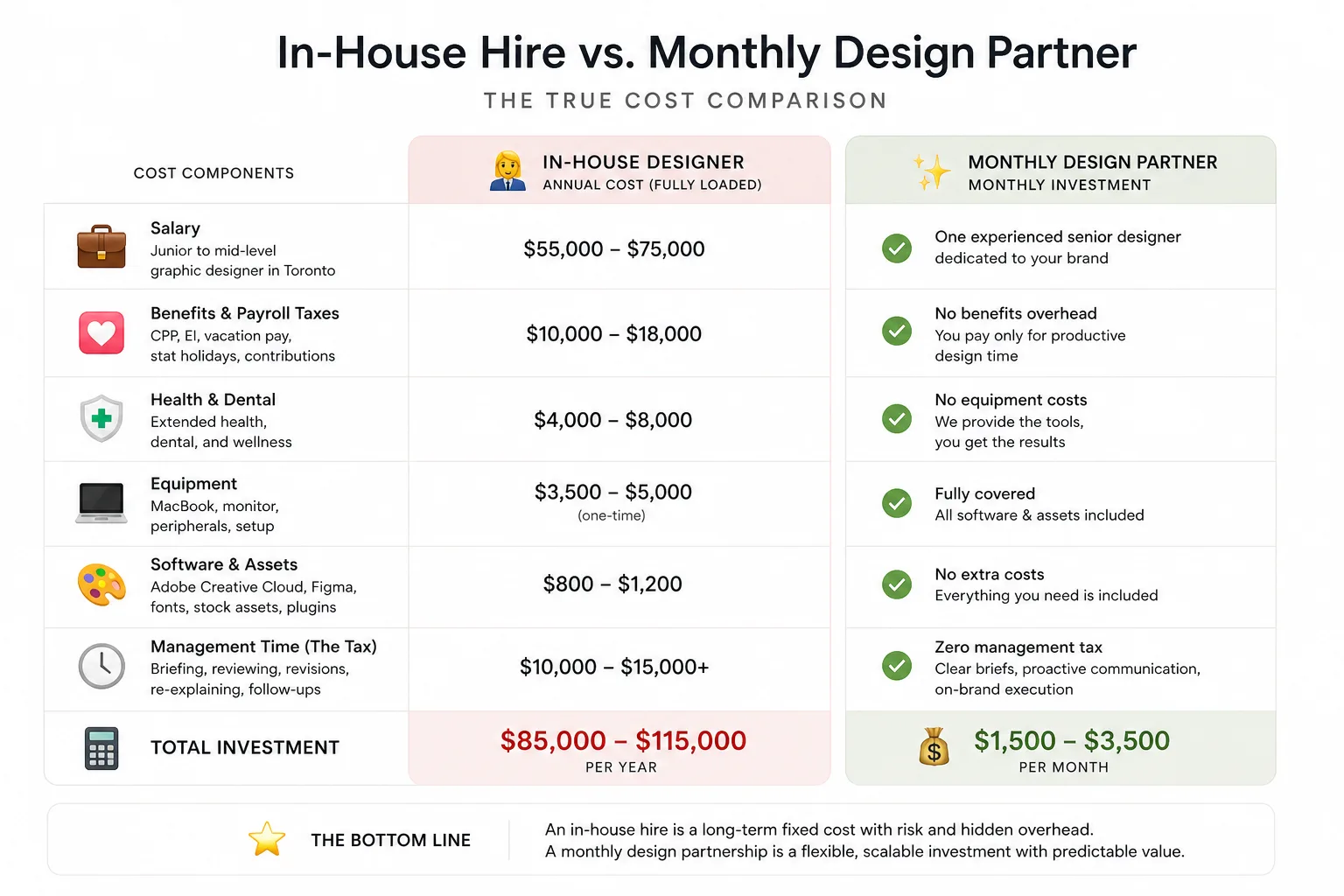
Above all, it is never just the salary. Data from Glassdoor shows that graphic designer salaries in Toronto typically fall within the $55,000 to $75,000 range for junior to mid-level roles, depending on experience and company size. Notably, that figure excludes benefits, equipment, and software entirely. Add employer contributions — CPP, EI, vacation pay, and stat holidays and the base cost increases significantly. Extended health and dental add another $4,000 to $8,000 per year. Equipment alone runs $3,500 to $5,000 upfront. Software adds $800 or more per year for Adobe Creative Cloud, Figma, and stock assets. In total, the fully loaded cost of a mid-level in-house designer in the GTA sits at $85,000 to $115,000 per year.
Furthermore, there is what experienced operators call the Management Tax. In practice, this is time spent reviewing work, re-explaining your vision, and revising materials that are still not quite right. Founders who hire expecting to remove creative work from their plate often find they have simply created a new management layer instead. Moreover, one designer has a creative ceiling — they handle production, but they are not simultaneously your brand strategist, presentation specialist, and proposal designer. As your business grows, the gap between what one person can do and what your firm actually needs grows with it.
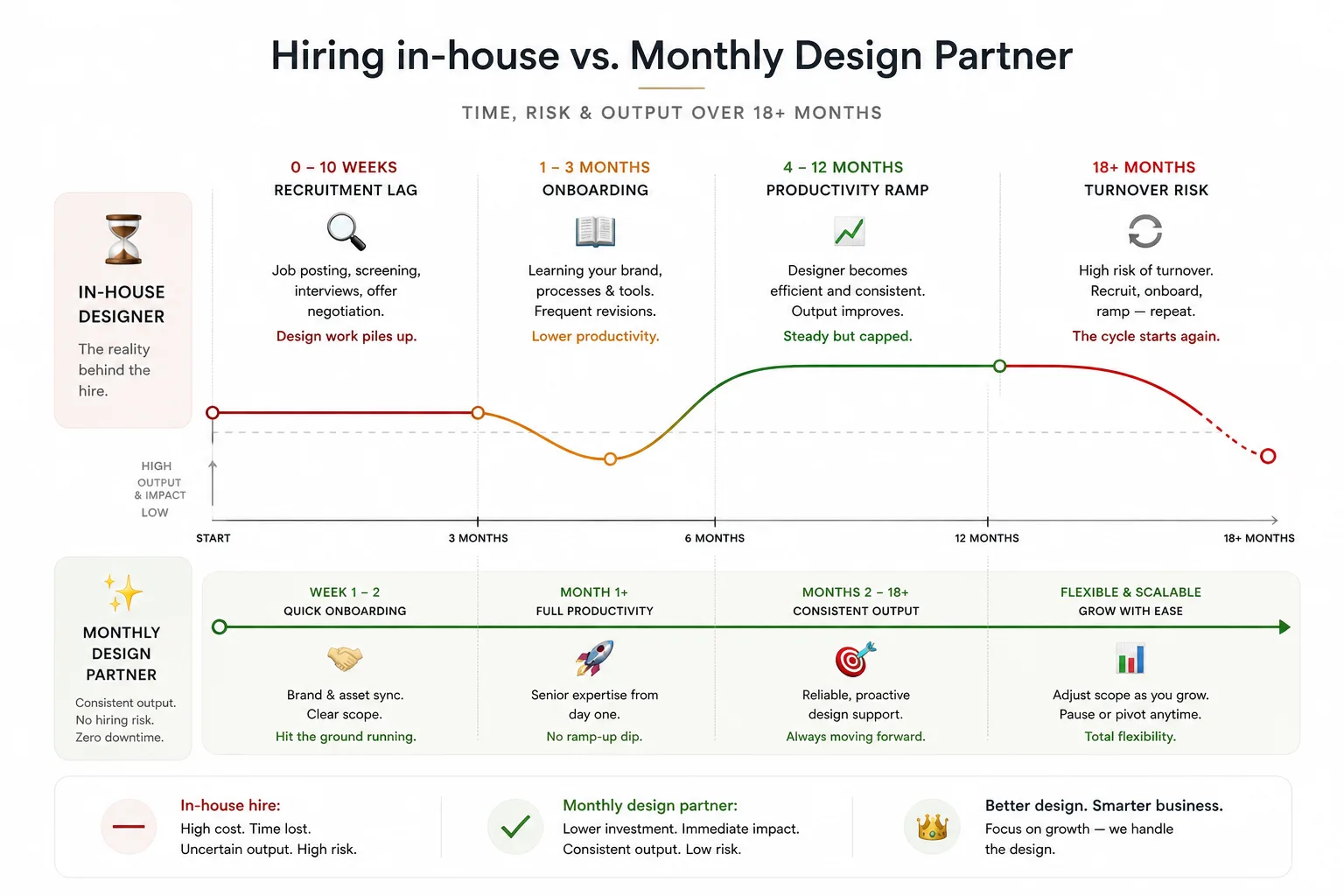
The Management Tax compounds over time in ways that are difficult to predict at the time of the hiring decision. In month one, you are investing heavily in onboarding. By month three, the volume of reviews has dropped, but quality questions are still frequent. At month six, you have a designer producing competently; however, you are still the quality control mechanism for every client-facing deliverable. In-house employment is a long-term management relationship, not a one-time investment.
The Recruitment and Retention Problem
Hiring a designer in Toronto's current market takes significant time. A credible job posting, screening, interviews, and offer negotiation typically take six to ten weeks. During that window, your design needs do not pause — they accumulate. Once you have hired, retention introduces its own risk. Data from the U.S. Bureau of Labor Statistics shows that median employee tenure in professional roles is relatively short, particularly among younger and mid-career workers, who are more likely to change jobs in pursuit of higher compensation and broader experience. In practice, most employees are not staying in the same role long-term.
The tenure risk is particularly acute for scaling businesses. Specifically, a designer whose output is pitch decks and LinkedIn graphics for a growing consultancy is not building the portfolio they need to advance. Their career goals and your business needs are structurally misaligned from day one. That creative mismatch creates a slow-burning retention problem. In reality, the hire you thought would solve the problem simply defers it by 18 to 24 months. Ultimately, you absorb the full cost of the cycle again.
What an In-House Hire Cannot Give You
An in-house junior designer gives you production capacity. However, production capacity is not the same as design intelligence. They typically cannot give you the strategic perspective of a senior designer who has worked across multiple businesses, industries, and content types. They know only your firm, because they have only ever worked for it. A dedicated design partner who works with multiple scaling businesses brings cross-sector pattern recognition. That is something no single in-house hire can replicate.
There is also the coverage problem to consider. When your in-house designer is on holiday, sick, or in a heavy production week, your marketing does not stop needing attention. A monthly design partnership maintains consistent output regardless of what is happening internally. As a result, coverage gaps never become your problem.
If you are trying to understand the full scope of what the design function is currently costing your business — in time, management overhead, and brand consistency — this post on the founder's design bottleneck makes the case in detail.
The Third Option: A Dedicated Monthly Design Partner
The most strategically efficient growing businesses in the GTA are not choosing between hiring someone and staying on Fiverr. Instead, they are choosing a third path: a dedicated monthly design partner who brings senior-level creative capability without the overhead of a full-time hire. This is the model Pixie Creative offers to Toronto-based scaling businesses, agencies, consultancies, and services firms that produce consistent design-dependent marketing every month. Specifically, there are no recruiting fees, no benefits overhead, and no onboarding gap. One experienced senior designer learns your brand deeply and executes without hand-holding from day one.
The Numbers Side by Side
The comparison resolves clearly when you put the numbers side by side. In fact, most businesses that run it find the decision straightforward.
An in-house junior designer in Toronto, fully loaded over the first year, costs $85,000 to $115,000. That includes a six to ten week recruitment lead time and a four to eight week onboarding ramp before productive output. Additionally, it includes ongoing management overhead and a tenure risk of 18 to 24 months.
A Pixie Creative monthly partnership costs $1,500 to $3,500 per month. Two-week brand onboarding gets you to full productivity fast. Furthermore, there is zero management overhead and senior-level output from the first deliverable. The risk profiles are not comparable. A full-time hire is a long-term fixed cost with variable output quality. A monthly partnership is a flexible, scalable cost with a 30-day notice exit and no HR administration. For a business in a growth phase where flexibility and reliability both matter, the monthly model wins clearly.
See exactly what a monthly design partnership costs at different scope levels.
Frequently Asked Questions
Is a monthly design partnership really equivalent to a full-time hire in terms of output?
For pitch decks, proposals, LinkedIn content, and marketing materials, a dedicated senior design partner typically produces equivalent or better output at a fraction of the fully loaded employment cost. The work that genuinely requires a full-time hire is high-volume production at a scale most $10M to $50M businesses have not yet reached. In reality, most scaling GTA businesses are nowhere near that threshold.
What if we are growing fast and will need more design capacity soon?
A monthly partnership scales with you. Specifically, scope adjusts as your needs grow — without a recruitment cycle, a ramp period, or a salary negotiation. Furthermore, if you eventually need an in-house designer, a design partner gives you a clear picture of your actual needs before you commit.
We already have a marketing manager — is a retainer still worth it?
A marketing manager and a design partner serve different functions. Notably, confusing those functions is one of the most common and costly mistakes scaling businesses make. Your marketing manager drives strategy, campaigns, and relationships. Specifically, that strategic work is where their salary earns its return. A design partner handles execution — so your marketing manager focuses on the work that justifies their hire. If you are not sure whether your business has crossed the threshold where dedicated design support makes sense, the five signs your business has outgrown the one-off design model gives you a clear checklist.
Before you hire someone full-time, have this conversation first. Book a discovery call with Pixie Creative.
Get in touchPixie Creative is a Toronto-based monthly design partner for GTA professional services firms — including law firms, consulting businesses, and financial services companies. Founded by Maryam, Pixie Creative provides dedicated design support without the freelancer chaos or subscription queue overhead.