At a certain point in a growing firm's life, the conclusion feels obvious: we need a designer. In fact, it is one of the most common inflection points for scaling GTA businesses. A real designer. Someone in-house. The marketing is lagging, the brand is inconsistent, and the marketing manager is drowning in design overflow. A full-time hire feels like the logical next step. However, the economics rarely work out the way the decision feels. Before posting that job description, it is worth understanding the real cost of that hire. A different model may deliver what you need without the overhead, the commitment, and the risk.
What a Full-Time Junior Designer Actually Costs in Toronto
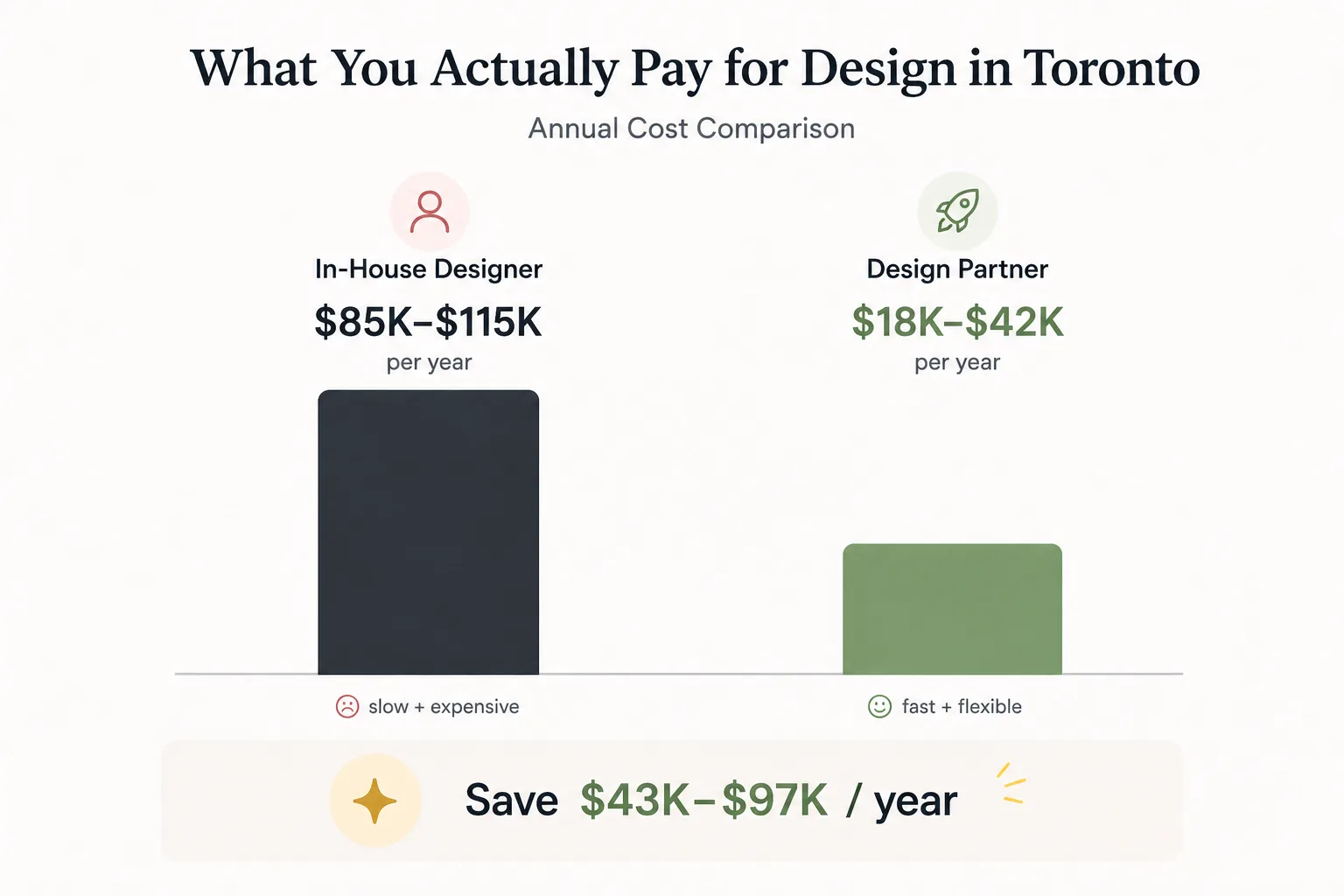
Above all, it is never just the salary. Notably, that figure excludes benefits, equipment, and software entirely. According to the Government of Canada Job Bank, graphic designers in the Toronto region typically earn between $50,000 and $80,000 depending on experience. However, base salary is only one component of the real cost. Add employer contributions — CPP, EI, vacation pay, and stat holidays — and the base cost rises significantly. Extended health and dental add $4,000 to $8,000 per year. Equipment alone runs $3,500 to $5,000 upfront. Software adds another $800 per year. In total, the fully loaded cost sits at $85,000 to $115,000 per year.
Furthermore, there is the recruitment overhead that most hiring managers underestimate. Finding a credible junior-to-mid designer in Toronto's current market takes six to ten weeks of active recruiting. That includes job posting fees, screening time, interview time, and offer negotiation. During that window, your design needs accumulate. Specifically, every delayed project adds to the backlog you will hand to a designer who is not yet productive. Once you have hired, there is a further four to eight week onboarding ramp before productive output. Consequently, you have spent four months without adequate design support.
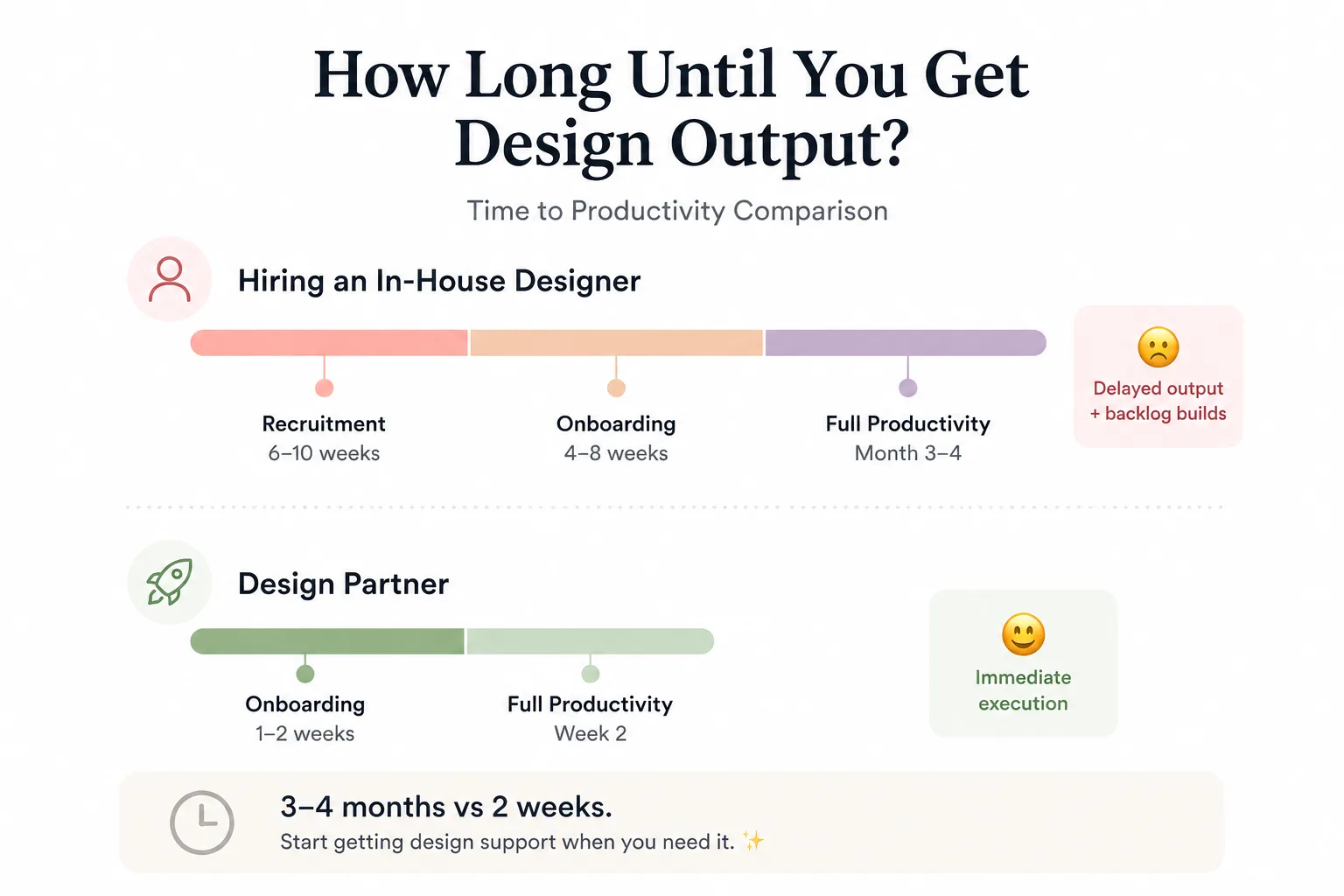
Furthermore, there is the recruitment overhead that most hiring managers underestimate. Finding a credible junior-to-mid designer in Toronto's current market takes six to ten weeks of active recruiting. That includes job posting fees, screening time, interview time, and offer negotiation. During that window, your design needs accumulate. Specifically, every delayed project adds to the backlog you will hand to a designer who is not yet productive. Once you have hired, there is a further four to eight week onboarding ramp before productive output. Consequently, you have spent four months without adequate design support. Research from McKinsey & Company consistently highlights how talent churn and role misalignment create compounding operational drag — not just replacement cost, but lost productivity, delayed execution, and reduced team velocity. At that point, you absorb the full cost of the cycle again.
What You Are Actually Trying to Solve
The real problem is not that you need a person in a seat. Specifically, the problem is that you need reliable, consistent design output every month. Managing it yourself or running it through a stretched marketing manager is not the right solution. Those are different requirements. Notably, most founders conflate them when making the hiring decision. The second one does not require a full-time hire to solve. In other words, you may be buying a $95,000 solution to a $3,000 problem. Understanding that distinction is the difference between a significant annual commitment and a monthly investment that delivers the same outcome.
The Model That Solves the Actual Problem
A dedicated monthly design partnership delivers brand knowledge, consistent output, and proactive support — without the salary, benefits, equipment, and administrative cost. For most growing GTA businesses, a senior design partner at $1,500 to $3,500 per month delivers more value than a junior in-house hire at $6,000 to $8,000 per month all-in.
The comparison most founders find most persuasive is not the cost comparison. Instead, it is the capability comparison. A junior in-house designer gives you production capacity. Ultimately, that is all they give you. By contrast, a dedicated design partner gives you cross-sector pattern recognition built across multiple businesses and industries. They only know your firm — because they have only ever worked for it. In other words, you get a qualitatively different kind of creative intelligence. A dedicated design partner who works with multiple growing businesses brings cross-sector pattern recognition. That is something no single in-house junior hire can replicate. Furthermore, it compounds over time as the partner learns more about your business.
There is also the coverage problem that in-house hiring does not solve. When your in-house designer is on holiday, sick, or in a heavy production week, your marketing does not stop needing attention. A monthly design partnership maintains consistent output regardless of what is happening internally. As a result, coverage gaps never become your problem.
This post on stopping weekend design overflow explains exactly how much time the design function is currently consuming across your team and what removing it from your plate actually looks like in practice.
The Numbers Side by Side
In-house junior designer, Toronto, first year fully loaded: $85,000 to $115,000. That includes a six to ten week recruitment lead time, a four to eight week onboarding ramp, and ongoing management overhead throughout. Additionally, it includes the tenure risk. Statistically, you rebuild this from scratch within two years.
Pixie Creative monthly partnership: $1,500 to $3,500 per month depending on scope. Two-week brand onboarding to full productivity. Zero management overhead. Senior-level output from the first deliverable. Furthermore, the relationship builds in value over time. By month six, accumulated brand knowledge makes every project faster and better.
In reality, the choice is between a fixed, high-risk employment commitment and a flexible creative partnership that costs a fraction of the equivalent headcount. This breakdown of what a monthly design retainer actually costs in Toronto gives you the full picture on scope, tiers, and what you get at each level.
Frequently Asked Questions
At what revenue level does an in-house designer actually make sense?
In practice, an in-house hire makes economic sense when your business produces forty or more design assets per week at consistently high complexity. For most growing GTA businesses at the $5M to $50M revenue stage, that threshold is not yet reached. Specifically, a scoped monthly partnership handles the actual volume most businesses produce without the fixed overhead of a full-time hire.
What if we eventually want to hire in-house — does a retainer help us get there?
Yes — and it is one of the most practical reasons to start with a partnership before hiring. A six-month partnership gives you a precise picture of your actual design volume and workflow preferences before you commit to a full-time hire. Consequently, when you do hire, you hire for the role you actually need rather than the one you thought you needed. If you are not sure yet whether you have crossed the threshold where dedicated support makes sense, the five signs your business has outgrown the one-off design model gives you a clear checklist.
We have a marketing manager who is currently handling our design. Is a retainer still worth it?
Almost certainly. A marketing manager should spend their time on strategy, campaigns, and partnerships — not in Canva. Indeed, a dedicated design partner gives that capacity back entirely. If your marketing manager spends four or more hours per week on design execution, that is four hours of strategic capacity going to graphic production. That is the most expensive misallocation most marketing managers have on their calendar — and the one that is easiest to fix structurally.
Before you hire someone full-time, have this conversation first. Book a discovery call with Pixie Creative.
Get in touchPixie Creative is a Toronto-based monthly design partner for GTA professional services firms — including law firms, consulting businesses, and financial services companies. Founded by Maryam, Pixie Creative provides dedicated design support without the freelancer chaos or subscription queue overhead.