Canva has become the default design tool for founders and marketing managers across Toronto and the GTA. It is fast, affordable, and requires no technical training — which is exactly why it has been adopted so widely.
For early-stage businesses, this makes complete sense.
But there is a very specific moment in a company’s growth where Canva stops being an advantage and starts becoming a constraint. That is the real inflection point in the Canva vs hiring a designer Toronto decision.
And most businesses don’t notice it until the impact is already visible — not in one design, but across the entire brand experience.
The cost shows up in three places: time, brand credibility, and the signals your marketing materials send to the clients you are trying to attract.
Where Canva Works Well
Canva is genuinely effective in early-stage business environments.
If your brand is still evolving, your messaging is still being tested, and your marketing output is inconsistent, Canva provides a fast, accessible way to produce content without needing a design system in place.
It works well for:
Social media posts
Internal presentations
Early-stage brand experimentation
Quick marketing assets
At this stage, most businesses are not yet thinking deeply about DIY design vs professional designer Toronto comparisons. The priority is speed and visibility, not refinement.
It also helps that Canva has improved significantly over the years. Features like brand kits, team collaboration, and expanded templates make it far more capable than its early versions.
For early-stage companies, Canva still fits within that threshold.
But that changes quickly as a business grows.
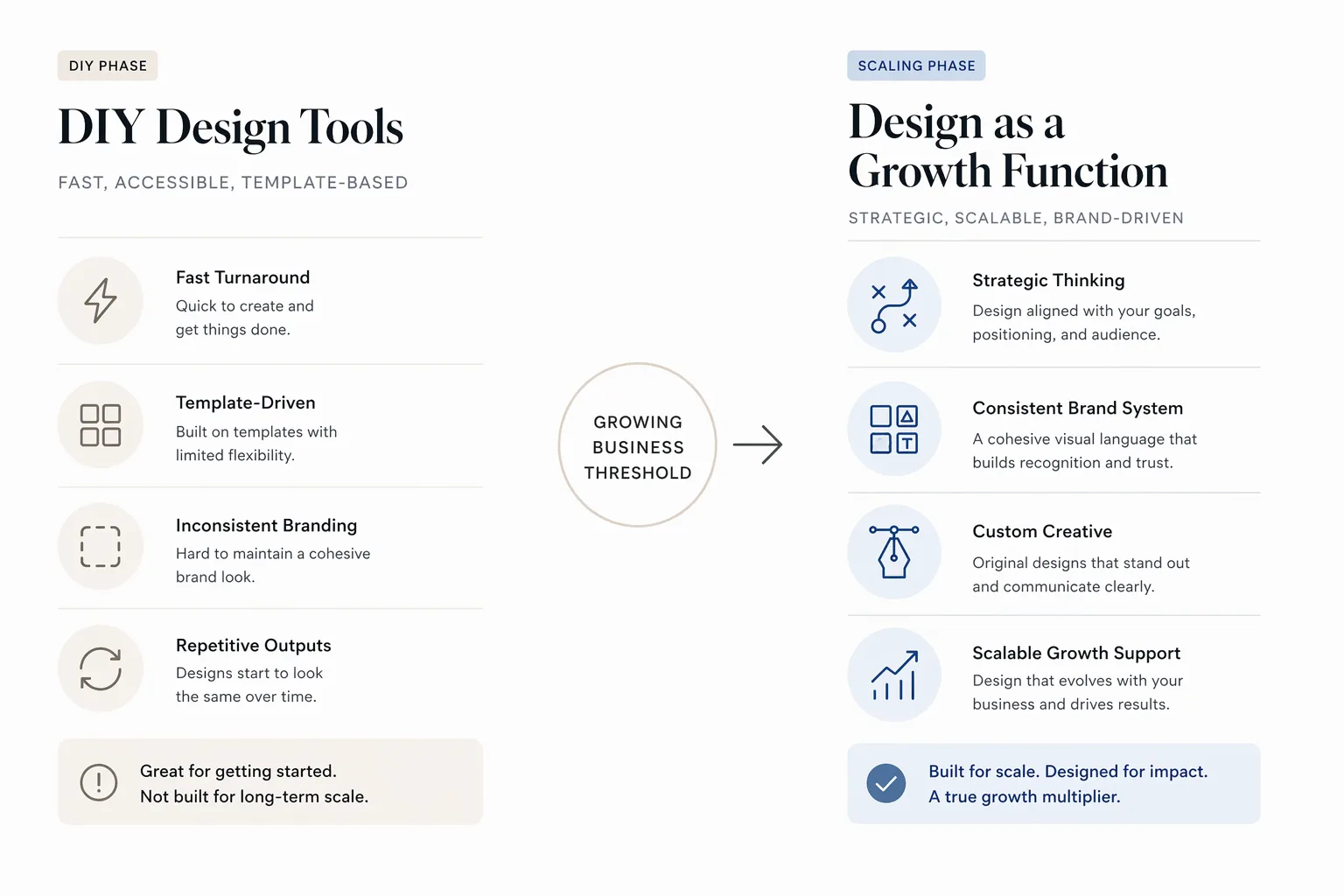
Where Canva Starts to Break for Scaling Businesses
1. Time stops being “cheap”
Canva feels cost-effective until you calculate the actual time investment behind it.
For founders and marketing managers, design work becomes a recurring operational task rather than a creative activity. Hours are spent adjusting layouts, resizing content, and fixing inconsistencies.
This is often the first sign of when to stop using Canva marketing team workflows — when design begins competing with strategic priorities instead of supporting them.
The tool is inexpensive. The time cost is not.
2. Your brand starts looking like everyone else
This is where the problem becomes more visible externally.
Canva’s template system is both its strength and its limitation. Because millions of businesses use the same underlying structures, visual repetition becomes unavoidable.
Even with customization, the composition often remains recognizable.
This is where many companies begin searching for Canva alternatives professional services GTA, especially when trying to differentiate in competitive markets.
As noted in research cited by the Nielsen Norman Group, users form an opinion about a website in as little as 50 milliseconds (Lindgaard et al., 2006), shaping perceptions of trust and credibility almost instantly.
If your brand looks templated, that perception changes instantly.
3. Brand consistency quietly breaks down
Without a dedicated designer or structured design system, inconsistencies naturally accumulate.
Fonts shift slightly. Spacing changes. Colours drift. Layouts vary depending on who creates the content.
Individually, nothing feels incorrect.
But over time, the brand begins to fragment.
This is where many businesses realise they have already outgrown Canva growing business GTA workflows without noticing it.
We explore this further in our breakdown of why your brand looks inconsistent, where small design inconsistencies compound into long-term brand dilution.
4. Canva has no strategic intelligence
This is the most important limitation — and the one most businesses only recognise at scale.
Canva executes design. It does not make decisions.
It will not question:
Whether the content is necessary
Whether the format matches the audience
Whether the timing supports your strategy
But growing businesses do not just need execution — they need direction.
This is where the gap between DIY design vs professional designer Toronto becomes unavoidable.
Design shifts from production to positioning.
The Moment Businesses Realize They’ve Outgrown Canva
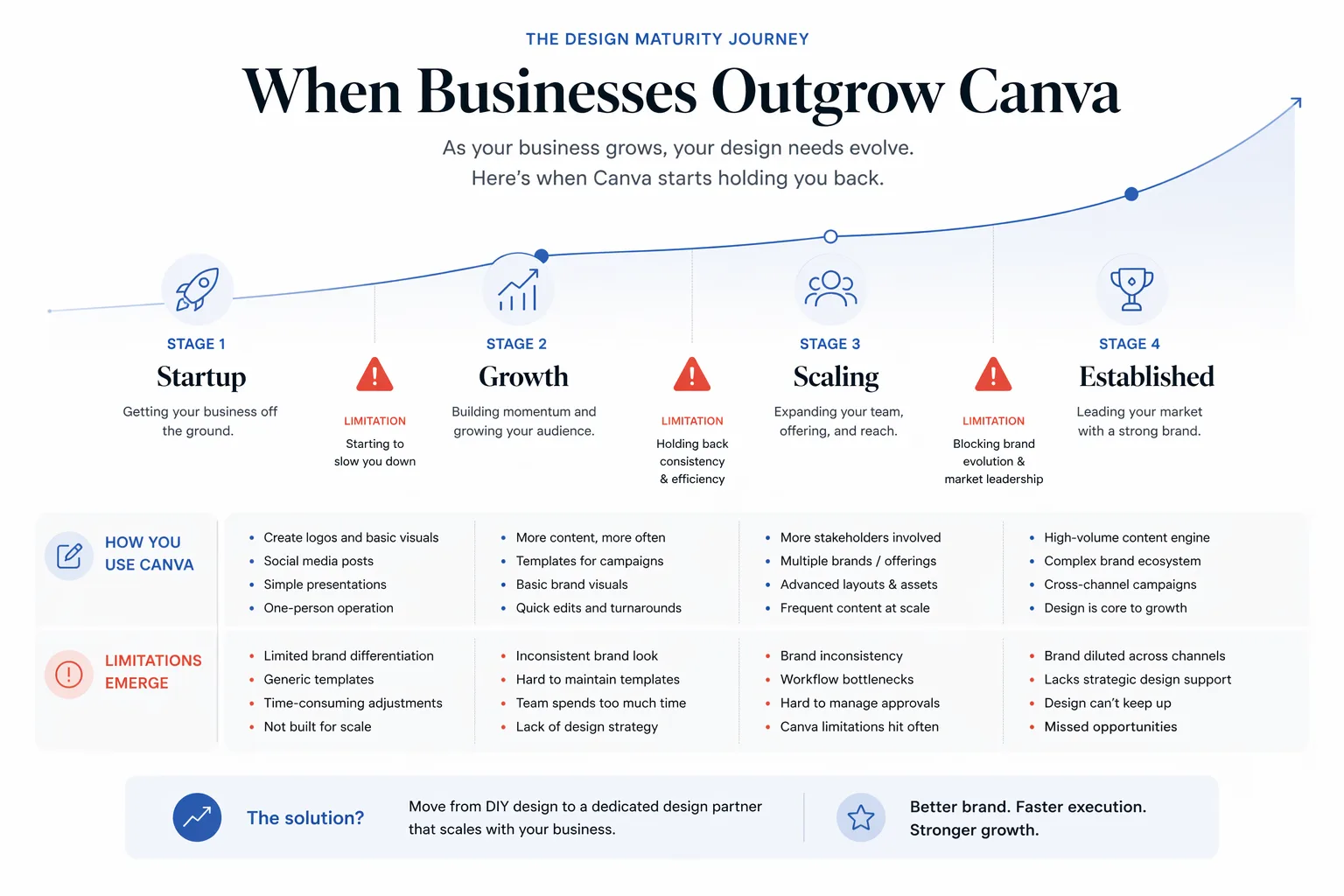
Most companies do not actively decide to leave Canva.
Instead, they feel friction building over time:
Marketing takes longer than it should
Visual identity feels inconsistent
Content no longer feels premium
Output feels “slightly off” compared to competitors
This is typically the stage where Canva stops being a tool and starts becoming a limitation.
At that point, the canva vs hiring a designer Toronto question is no longer theoretical — it is operational.
The Option Most Businesses Overlook
Most founders assume there are only two paths:
Continue using Canva internally
Hire a full agency or in-house designer
But there is a third option that sits between them.
A dedicated monthly design partner.
This model provides consistency without the overhead of traditional agencies and without relying on fragmented internal Canva usage.
Instead of constantly rebuilding briefs or fixing visual inconsistencies, businesses operate with an embedded design system that evolves with them.
This is where solutions like Pixie Creative sit — bridging the gap between DIY tools and full agency infrastructure. It directly addresses the gap many businesses experience when searching for Canva alternatives professional services GTA.
If you're still using Canva for client-facing work and wondering whether your brand is holding you back, the posts on why your brand looks inconsistent and the real problems with the freelancer model are worth reading before making any decisions about your design setup.
Why This Shift Matters
Design is no longer just visual — it is a trust signal.
According to research on creative performance and brand systems, consistent visual design and branding significantly improve user recognition, trust, and overall engagement. In fact, consistent brand presentation across platforms can increase revenue by up to 23% (Lucidpress, 2019).
In competitive markets like Toronto and the GTA, this directly impacts conversion and positioning.
What Changes When You Move Beyond Canva
Once businesses transition away from Canva for client-facing work, the shift is immediate:
Brand consistency improves
Marketing becomes faster and more structured
Teams regain strategic time
Client-facing materials feel more premium
Design stops being reactive and becomes systematic
This is often when businesses fully understand the real difference behind the canva vs hiring a designer Toronto decision.
FAQ
When should a business stop using Canva?
A business should move away from Canva when design becomes time-consuming, inconsistent, or no longer reflects the quality of the brand as it grows.
Is Canva enough for growing businesses in Toronto?
Canva works well in early stages, but most growing Toronto businesses eventually outgrow it as they require stronger brand consistency and strategic design support.
Why does Canva make brands look similar?
Because it relies heavily on shared templates used by millions of businesses, which creates visual repetition across industries.
What is better than Canva for professional branding?
Businesses typically move toward professional designers, design systems, or monthly design partnerships that ensure consistency and strategic alignment.
Final Thought
Canva is not the problem.
The problem is staying in a stage of business where it is no longer sufficient.
The canva vs hiring a designer Toronto decision is not about tools — it is about maturity, scale, and brand positioning.
And for many businesses in the GTA, that transition has already quietly begun.
If you're questioning whether your business has outgrown Canva, you're likely already in the transition phase.
Get in touchPixie Creative is a Toronto-based monthly design partner for GTA professional services firms — including law firms, consulting businesses, and financial services companies. Founded by Maryam, Pixie Creative provides dedicated design support without the freelancer chaos or subscription queue overhead.