Outsourcing design is one of the most common operational decisions for growing businesses in Toronto. Indeed, most growing GTA businesses attempt it at least once before finding a model that actually works. Notably, it is also one of the most misunderstood. Most founders and marketing managers go in expecting to save time. In reality, many discover they have simply changed what they spend time on.
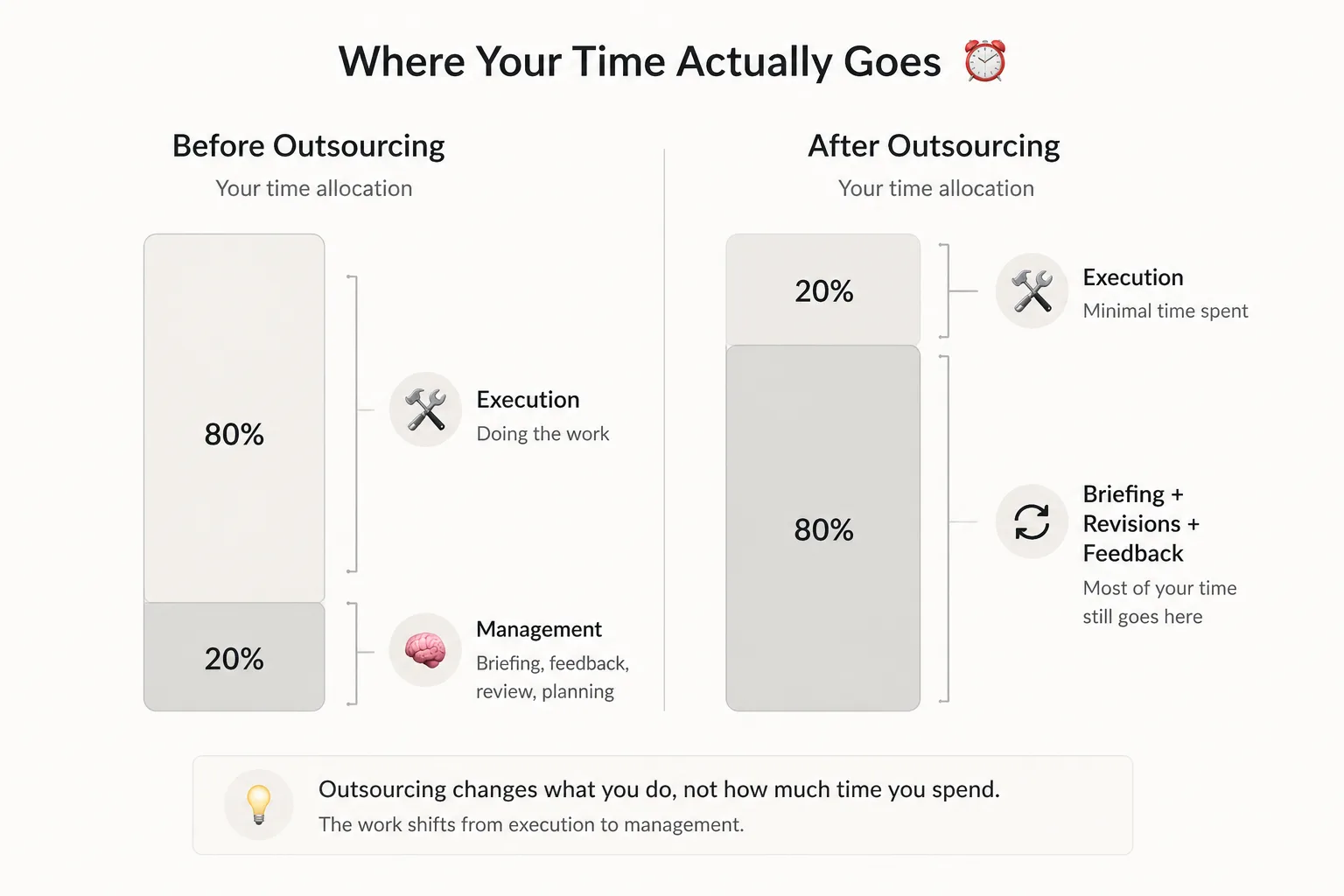
This post gives you an honest look at what actually happens across the three most common models. Specifically, it covers what to watch for before you commit to any of them.
Model 1: Freelancer Platforms (Fiverr, Upwork, 99designs)
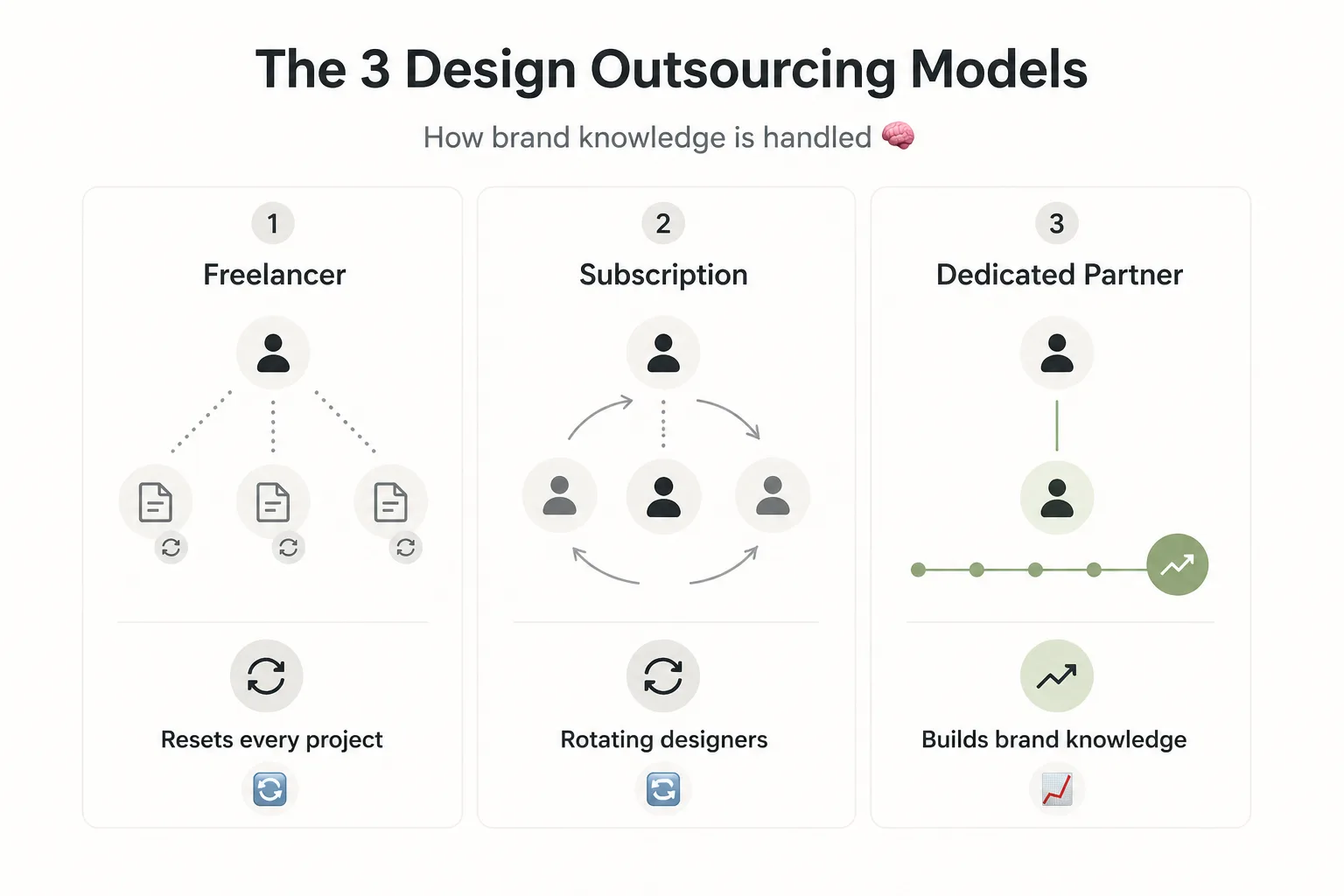
You post a brief, review proposals, select a designer, provide feedback, and approve the output. For one-off projects with clear specs — a logo, a banner, a simple graphic — this can work acceptably. However, that is the ceiling of what the model reliably delivers.
Quality uncertainty is the second problem. It is difficult to manage from a distance. A designer's portfolio may look strong. Their work for your specific brief, on the other hand, may not match it. Consequently, revision cycles on platform-sourced work run longer than expected. Specifically, the designer calibrates to your standards in real time — on your time.
For growing GTA businesses where every client-facing deliverable signals brand quality, this calibration overhead is genuinely costly. It is not just a time cost. The output quality of those first few projects suffers while the designer figures out what you actually want. By the time they understand your standards well enough to work efficiently, the project ends and the relationship with it. The next project starts the calibration process again from zero. Ultimately, this is the fundamental structural failure of the platform model for any business with ongoing design needs.
This compounding reset is the same structural failure explained in our post on why the freelancer model fails growing GTA businesses. The model resets your brand knowledge with every new engagement.
Model 2: Unlimited Design Subscriptions (Design Pickle, ManyPixels, Teamtown)
You pay a flat monthly fee and submit design requests to a queue. A designer — often different each time- executes your brief and returns the output. You review, revise, and manage quality. For businesses with high-volume, repetitive design needs, this model can work. In practice, it delivers volume efficiently. However, for growing agencies and professional service firms in the GTA, it replicates the freelancer management problem at scale.
You are still writing detailed briefs for every request. Revision and review still fall on you. In other words, you are still functioning as the creative director of your own brand — the platform just executes faster. The briefing overhead does not disappear.
Rotating designers create a specific brand consistency problem. Notably, it is the one subscription platforms are most reluctant to acknowledge. When the designer on your account changes — and in subscription models, this happens frequently — all accumulated brand knowledge disappears. The new designer works from whatever brief you write today. Consequently, every account change resets your brand knowledge to zero. For a growing business where brand nuance matters, this reset is not a minor inconvenience. Indeed, it is a structural barrier to the consistency that premium positioning requires.
There is also a quality ceiling that subscription services rarely acknowledge openly. The business model of unlimited design at a flat fee requires high throughput. High throughput requires designers to work quickly. Working quickly means gravitating toward simpler, more predictable briefs. Consequently, the most important deliverables — the pitch deck, the proposal, the thought leadership piece — come back most in need of revision. The platform's incentives and a growing business's needs are structurally misaligned.
Research from Nielsen Norman Group shows that complex, context-heavy design work consistently suffers without deep user and brand understanding.
Model 3: Dedicated Monthly Design Partner (Pixie Creative)
One senior designer embeds in your business from the start. A structured onboarding session transfers your brand knowledge entirely. Furthermore, it produces a formalised brand reference document that serves as the working brief for all future requests. From that point, you share what is coming up and the work gets handled. No detailed briefs, no revision marathons, and no quality control falling back to you.
This is the model that actually removes design from your plate. Specifically, not just the execution — the thinking, the briefing, and the quality management too. The difference is brand intelligence. A dedicated partner six months in makes creative decisions from a deep understanding of your brand, your clients, and your competitive positioning. Furthermore, no brief can transfer that understanding. Only time and relationship build it.
This breakdown of what a monthly design retainer actually costs in Toronto explains exactly what you get at each scope level and how the numbers compare to what most growing businesses are already spending.
The Question to Ask Before You Commit to Any Model
Most businesses fall into the same trap when outsourcing design: assuming that handing it off means it is handled. Outsourcing without a clear model for brand knowledge transfer creates a different set of problems. You notice them when a key deliverable goes to an important client and does not look like the business you have built.
Before committing to any model, ask one question: who is accountable for brand consistency, and how does that actually work in practice? If the honest answer is you — through ongoing briefing and review — you have not outsourced design. In other words, you have outsourced execution while retaining the management work. Above all, the only model that truly removes design from leadership's plate is one where a dedicated partner owns brand accountability as their primary job.
If you are not sure where your business currently sits, this checklist of five signs you have outgrown the one-off design model makes the decision straightforward.
Frequently Asked Questions
We tried a subscription service and it did not work. Is the model worth trying again?
Subscription services work well for a specific type of business — high volume, repetitive output, simple briefs. If that does not describe your business, the model was the wrong fit regardless of the platform. Specifically, growing agencies and professional service firms in the GTA almost always find the management overhead too high and the brand consistency too low. The dedicated partner model addresses both problems structurally.
How is a dedicated design partner different from just having a regular freelancer we use often?
Three critical differences stand out. Specifically, they are the ones that determine whether the relationship solves your problem or replicates it. First, context: a dedicated partner accumulates brand knowledge over time — a regular freelancer forgets between projects. Second, availability: a dedicated partner prioritises your work by definition. Third, accountability: a dedicated partner owns your brand quality as an ongoing responsibility. A freelancer owns only the specific deliverable they took on — nothing beyond it.
What does the onboarding process look like for a dedicated partner?
Pixie Creative's onboarding is a structured sixty to ninety minute session in week one. It covers your brand guidelines, your existing asset library, your target clients, your competitive positioning, and your upcoming projects. By week two, the designer produces work from that context without requiring detailed briefs for standard requests. As a result, most clients describe the briefing overhead dropping dramatically within the first month.
I am worried the quality from a solo designer will not match what an agency produces. Is that a fair concern?
It is a fair question — but the comparison is not solo designer versus agency team. It is one dedicated senior designer versus a rotating team of junior designers managed through an account executive. Insights from Harvard Business Review in “Redesigning Knowledge Work” show that high-value, knowledge-based work requires context and integration—not just task execution—something transactional design models rarely provide.
Find out which model fits your firm. Book a discovery call with Pixie Creative.
Get in touchPixie Creative is a Toronto-based monthly design partner for GTA professional services firms — including law firms, consulting businesses, and financial services companies. Founded by Maryam, Pixie Creative provides dedicated design support without the freelancer chaos or subscription queue overhead.