Here's something nobody says out loud at a networking event: the person handling the most design work at your firm is probably you. And your hourly rate is almost certainly the highest in the room.
Every hour you spend adjusting a pitch deck, reformatting a proposal, or hunting for the right logo file is an hour billed to your business at your full strategic rate — whether it shows up on an invoice or not. For GTA founders and marketing managers at professional services firms, this is the quiet arithmetic that nobody wants to do. So let's do it.
"Is it actually costing me that much to do my own design?"
Yes. Probably more than you think.
If your time is worth $300 an hour and you spend five hours a month on design tasks, tweaking decks, adjusting LinkedIn posts, and reformatting proposals before a client meeting, you've just spent $1,500 on work that a dedicated designer would do better, faster, and without needing to be managed. At six hours, you're at $1,800. At eight hours, $2,400.
Now compare that to what dedicated monthly design support actually costs. A flat-rate design partner in the GTA typically runs between $1,500 and $3,500 per month, depending on volume and scope. Unlike your late-night Canva session, that output is consistent, on-brand, and doesn't require three rounds of self-correction before it goes to a client.
The arithmetic is uncomfortable. But it matters.
The "I'll Just Do It Myself" Trap
Founders fall into this pattern for understandable reasons. It feels faster than explaining it to someone new. Nobody knows the brand like you do. It's "just a quick fix."
But this thinking is precisely what keeps growing premium businesses stuck. Every hour you spend on design is an hour not spent closing a high-value contract, developing a referral relationship, or thinking about where your business is going in the next 18 months. You are not saving money by doing your own design. You are paying a stagnation tax — and charging it to your business's future.
The trap deepens because of how poorly most founders estimate their design time. The actual hours in Canva or PowerPoint are just the beginning. There's also the time spent deciding what to make, mentally writing the brief, searching the shared drive for the correct logo version, reviewing the output before it goes out, and sending one more round of revisions. When GTA founders do a rigorous two-week audit of all design-adjacent time, the real number is typically 40 to 60 percent higher than their initial guess.
What Does DIY Design Actually Cost a GTA Firm? (The Full Maths)
Let's be specific.
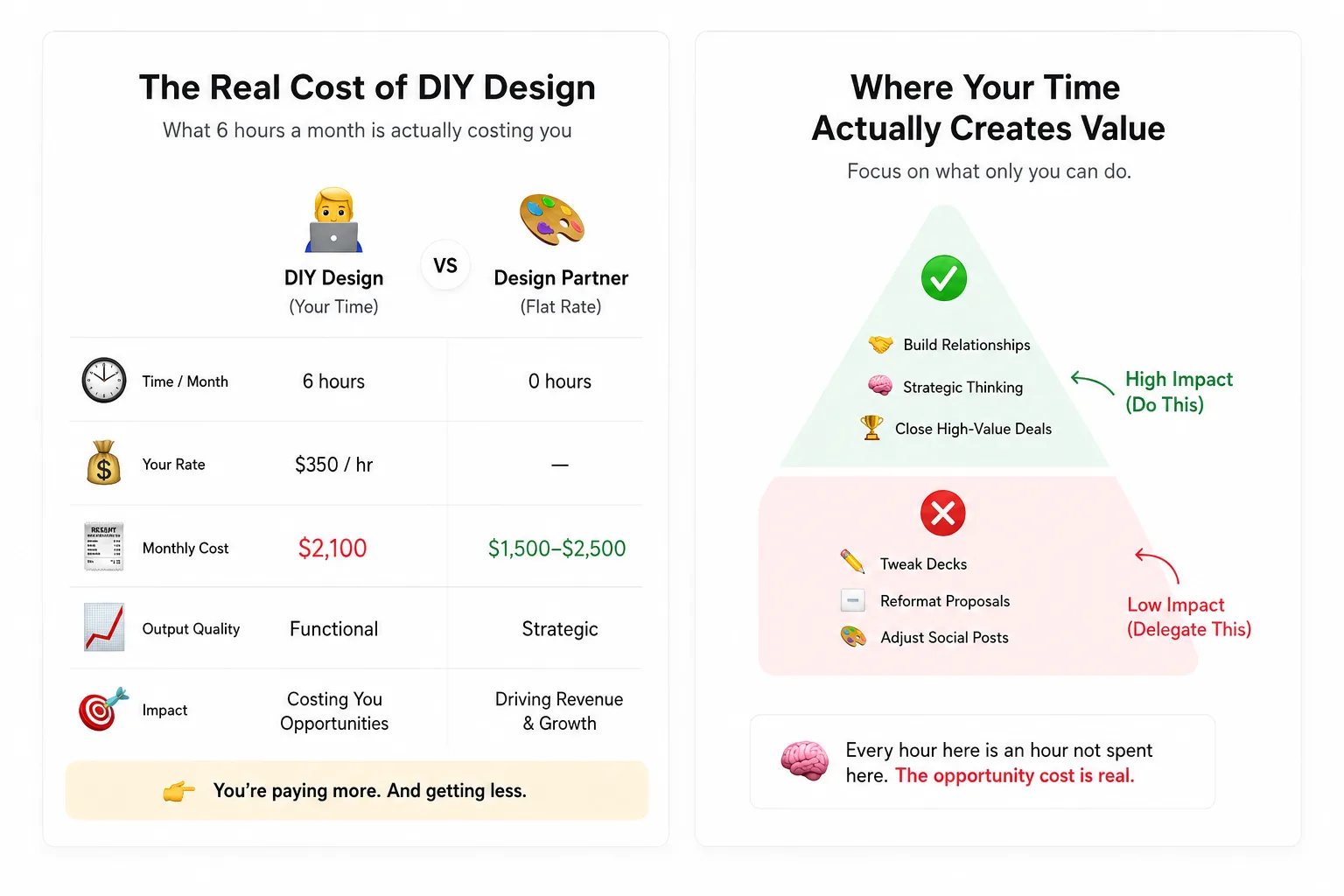
A founder billing at $350 per hour who spends six hours a month on design tasks is spending $2,100 per month in leadership time. A dedicated design partner for that same output runs $1,500 to $2,500 per month. The founder is paying more. And getting less.
The quality gap compounds the cost gap. The deck you built in two hours at 11pm before a pitch is functional. The deck a senior designer produces in the same time is persuasive. At the premium fee levels GTA professional services firms charge — $250 to $500 per billable hour — the difference between a good-looking proposal and an amateurish one can be the difference between winning and losing engagements worth tens of thousands of dollars.
According to research from McKinsey & Company, design-led companies outperform industry benchmark growth by up to 32 percent. The visual quality of your materials is not a cosmetic detail. It is a revenue driver. The design value case is documented extensively.
"But nobody knows my brand like I do"
This is the most common objection — and it's true for the first 18 months of a business.
After that, it becomes a bottleneck disguised as a quality standard.
A dedicated design partner, properly onboarded with real brand depth, produces work that is more consistent than what a founder produces under time pressure. The brand suffers more from reactive, rushed DIY output than it does from a designer who has invested in understanding it well.
There is also an unintended consequence to the "nobody knows the brand like I do" belief: it creates a single point of failure. If you are the only person who can produce on-brand materials, your brand's execution capacity is limited to whatever hours you can personally spare for it. For a growing premium business, that ceiling is a direct constraint on growth. Delegating brand execution to a trusted partner doesn't remove your influence. It removes the bottleneck.
The Opportunity Cost Nobody Calculates
The hours are only part of the equation.
The deeper cost is what didn't happen while you were doing design work. The follow-up call you didn't make. The referral relationship you didn't nurture. The proposal strategy you didn't think through properly. These opportunity costs are invisible on a spreadsheet — but they compound.
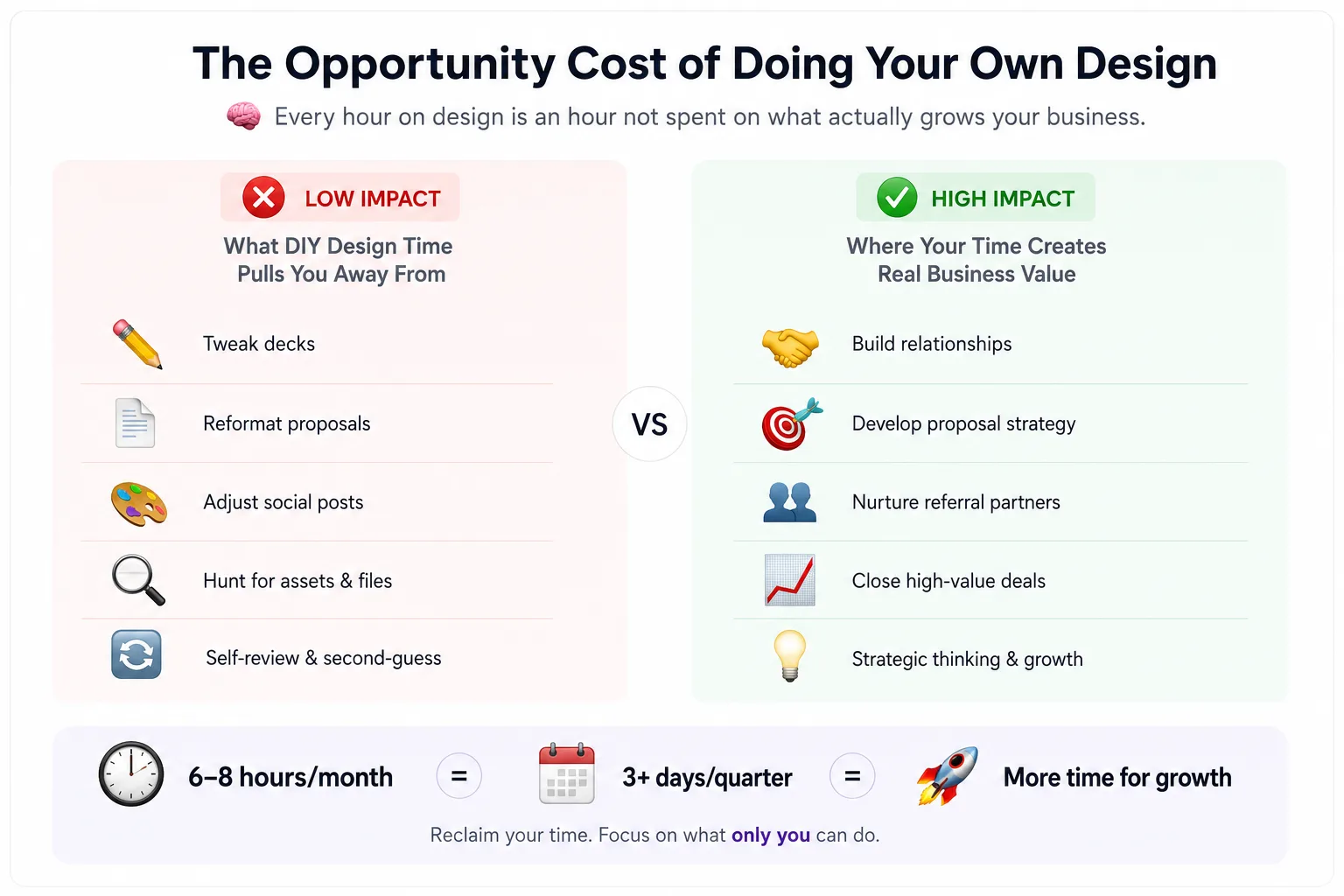
Executive time is the most finite resource a growing firm has and it's the one most founders spend least carefully. Context-switching between strategic thinking and low-value execution tasks like design doesn't just cost hours. It breaks the kind of deep focus that closing deals, building relationships, and running a team actually requires. HBR's research on where leadership time really goes makes the case plainly.
For founders of growing GTA premium businesses, this is the real argument against DIY design: not just that it costs money in time, but that it costs you the outcomes that come from spending that time on what only you can do.
No designer can close your deals, build your referral network, or develop your team. Only you can.
The Compounding Cost in Your Growth Window
The opportunity cost is particularly acute in the first three years of a premium business's growth phase.
This is when the relationships that will generate the next five years of referrals are being built — or not built. Every hour you spend in design during that window is an hour you're not spending on the relationship-building that premium GTA businesses run on.
The design work produces an asset with a relatively short useful life. A deck gets updated. A social post goes out and is seen once. The relationship-building work you skipped to do it might have produced a referral source that sends clients your way for a decade.
The math over three years is not close.
"When should I actually hire a designer?"
The honest answer: earlier than you think, and differently than you expect.
Most GTA founders wait until the pain is obvious — until a prospect comments on how the proposal looks, or until the LinkedIn profile is embarrassing enough to notice. By then, the cost has already been paid, just invisibly.
The smarter move is a dedicated design partner structure: one designer who already knows your brand, works within a predictable monthly fee, and doesn't require re-briefing every time. It's not the same as a project freelancer. It's not the same as hiring in-house. It sits in between and for growing professional services firms in Toronto, it's usually the structure that makes the most sense.
If you've wondered whether your pitch deck is doing its job or quietly costing you deals, that question is worth taking seriously. Here's what that founder bottleneck actually costs and how to get out of it.
What "Delegating Design" Actually Looks Like in Practice
A lot of founders hesitate because they imagine delegation meaning months of onboarding, endless back-and-forth, and output that still doesn't quite look right.
That's the freelancer experience. It's not what a dedicated design partner relationship looks like.
When you work with someone who has invested in understanding your brand at depth — your tone, your client types, your competitive context, the design standards that match your fees — the briefing time drops to almost nothing. You say what you need. It comes back right. You review once. It goes out.
The time you get back is not marginal. For a founder spending six to eight hours a month on design-adjacent tasks, recovering that time is the equivalent of adding a full strategic workday to every month. Over a quarter, that's three days. Over a year, that's two full weeks of leadership time redirected to the work that actually grows a premium business.
See exactly how the Pixie Creative retainer model works — scope, process, and what to expect.
The Question Worth Sitting With
If your business billed a client for the hours you spent on design last month, what would that invoice look like?
If that number is higher than what dedicated design support costs, you already have your answer.
Fire yourself from the design department. Use those hours for the work only you can do. And let someone who does this every day handle the rest — properly, on-brand, and without it ever landing back on your plate.
Ready to stop being your own designer? Book a free 30-minute walkthrough at pixiecreative.ca and see what consistent, senior-level design support actually looks like for a GTA firm at your stage.
Get in touchPixie Creative is a Toronto-based monthly design partner for GTA professional services firms — including law firms, consulting businesses, and financial services companies. Founded by Maryam, Pixie Creative provides dedicated design support without the freelancer chaos or subscription queue overhead.